Best Trash & Recycling Receptacles for Outdoor Pickleball Courts (2026)
By the PickleCourt USA team · Updated
The short answer
For most park, club and HOA courts, put a lidded trash and recycling pair at every gate. Victor Stanley's SD-242 does both in one side-door steel cabinet (two 36-gallon liners); its SD-42 is the single 36-gallon version. Wabash Valley's coated-steel Signature cans (32 and 55 gallons) are the color-matched option, with lids and post mounts sold separately. Pilot Rock's tilting 52-gallon basket saves staff from lifting bags, and its certified bear-resistant units suit resort and campground courts. Where wind, gulls or rats are the problem, Bigbelly's enclosed 47-gallon bins help, and its solar Smart Max compactor is for high-volume tournament sites.
Why courts need better bins than the rest of the park
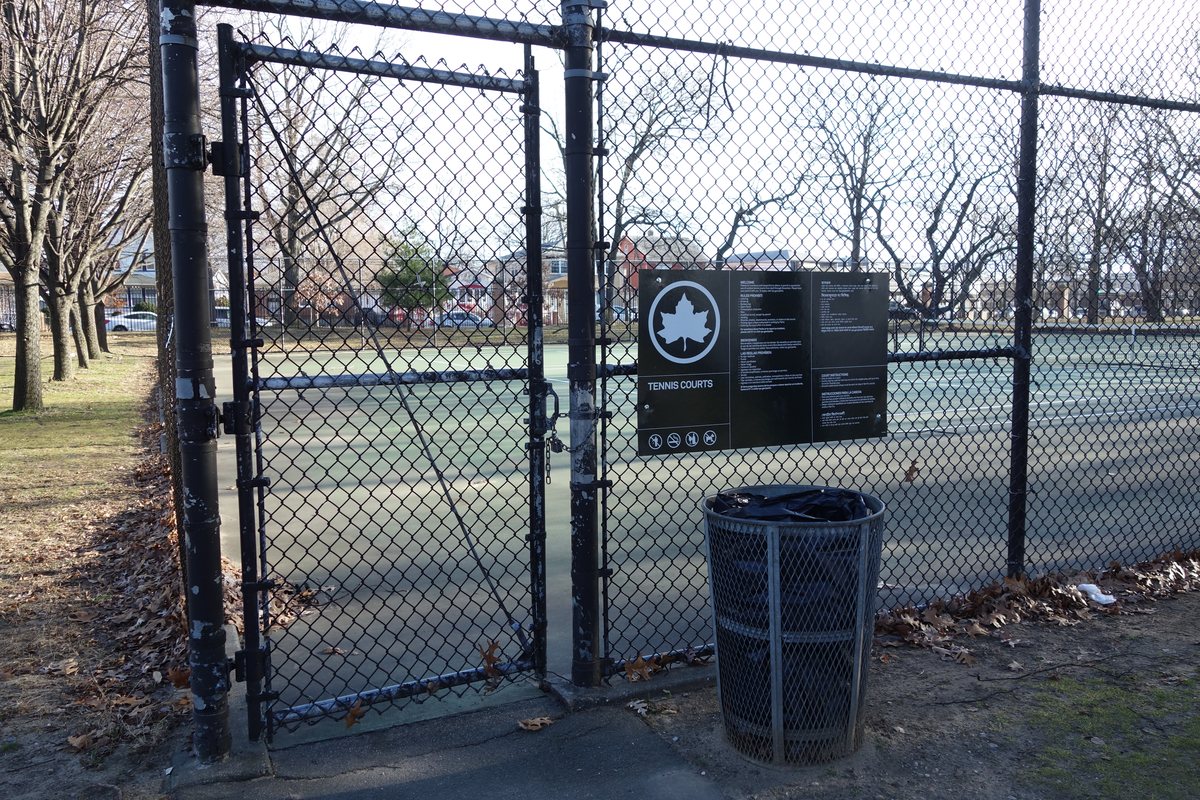
Pickleball courts produce a specific kind of litter: water and sports-drink bottles, coffee cups, overgrip and paddle-tape wrappers, snack packaging, the odd cracked ball. It collects at the gate, at the benches and along the fence line, as the photo above shows. An open can by the gate overflows on a busy open-play morning, wind lifts wrappers out and onto the playing surface, and a full bag soaked by rain is heavy enough that staff leave it. Litter on a court is more than a looks problem: a cup or wrapper on the surface is something a player can step on while moving for a ball.
The fix is not complicated: enough capacity at the right spots, lids that keep wind and rain out, a recycling stream next to every trash stream, a service method that does not depend on lifting, and mounting that keeps bins upright. This guide compares receptacles from four makers on exactly those points. If you are fitting out a whole site, it sits alongside our comparisons of shade structures and cabana benches, drinking fountains and bottle fillers and paddle racks.
How we compared
- Capacity, as the maker states it, and what the figure actually measures
- Service access: side door, tilting basket, front door or lift-out liner
- Lids and enclosure: open top, bonnet, dome, recycle and slotted lids, fully enclosed
- Recycling: a paired station or matching recycle lid
- Mounting: pedestal, embedded post, surface-mount plate or freestanding
- Animal resistance and accessible operation where the maker addresses them
Every figure comes from the maker's own product page or product sheet, read on November 24, 2026. We have not tested these receptacles, we have not invented ratings, and we do not list prices, which change and depend on options and quantity. The list is not ranked. Where a maker leaves something out, we say so.
Comparison table
| Receptacle | Capacity (maker) | Service access | Lid / enclosure | Mounting | Source |
|---|---|---|---|---|---|
| Ironsites SD-42 side-door receptacle Victor Stanley · Powder-coated steel (TGIC polyester), high-density plastic liner, rubber-tipped leveling feet | 36 gal (136 L) | Side door on stainless-steel hinge pins with self-lubricating brass bushings; latch; keyed lock optional | Tapered formed lid standard; dome, convex, rain bonnet, spherical dome, enclosed dome and recycle lids optional | Bottom recessed pedestal | Maker page |
| Ironsites SD-242 recycling station Victor Stanley · Powder-coated steel; same side-door hardware as the SD-42 | Two 36 gal (136 L) liners | Side door; latch; keyed lock optional | Two lids in any mix of tapered formed, recycle and slotted; dual-flow lid optional; optional standard decal package | Bottom recessed pedestal | Maker page |
| Ironsites S-4524 and S-42 top-load receptacles Victor Stanley · Powder-coated steel; lid attached to the frame with two vinyl-coated steel aircraft cables; plastic liner | 45 gal (170 L) for S-4524; S-42 capacity not stated on its product page | Lift the lid and pull the liner up and out | Tapered formed lid standard; dome, convex, rain bonnet, spherical dome and recycle lids optional | Bottom recessed pedestal; rubber-tipped leveling feet | Maker page |
| Signature Perforated receptacle (with door) and 55-gallon perforated Wabash Valley · Steel with Wabash Valley's plastisol coating; liner included on the 55-gal model | 32 gal (with door); 55 gal model also listed | Side door on the door version; top-load otherwise | Sold separately: flat top, flat top with bonnet, dome top, 55-gal bonnet and a recycle flat-top lid | Freestanding, or with the maker's in-ground or surface-mount post packages | Maker page |
| Rinnova receptacle with liner Wabash Valley · Steel frame with recycled-plastic lumber slats; liner included | Not stated in the product description | Top-load | Sold separately | Not stated in the description | Maker page |
| Tilting Trash Receptacle CN-TR-52 Pilot Rock (RJ Thomas Mfg.) · Thermoplastic-coated basket; one-piece 2-3/8 in OD steel pipe yoke on twin pedestals, powder-coated | About 52 gal perforated steel basket | Spring-loaded pin locks the basket upright or tilted to 60 degrees for unloading; uses ordinary trash bags, no separate liner | No lid listed; solid band around the basket for cut-in signage or decals | Embedded posts (CN-TR-52) or bolt-down base plates (CN-TR/P-52) with concrete anchor bolts included | Maker page |
| Bear-resistant trash and recycling receptacles (BPRT series) Pilot Rock (RJ Thomas Mfg.) · Steel | See the series page for sizes | Latched against wildlife; details per model on the series page | Enclosed, certified bear-resistant | See the series page | Maker page |
| Bigbelly Element and Smart (enclosed, non-compacting) Bigbelly · Fully enclosed bin; corrosion-resistant materials, per maker | 47 gal (178 L) inner bin | Enclosed chute or hopper with hands-free foot pedal; front service door | Fully enclosed (no open top) | Standalone or combined into a multi-stream kiosk | Maker page |
| Bigbelly Smart Max (solar compacting) Bigbelly · Galvanized steel inside and out, recycled-plastic side panels, LDPE inner bin; 40 W solar panel | Bigbelly: 32 gal of compacted trash, about 150 gal uncompacted | Hopper (15 x 5 x 6 in opening) or chute; foot pedal; handle height 41.8 in; collection door locks when closed | Fully enclosed | Freestanding unit, 49.8 x 25 x 26.8 in, 260 lb | Maker page |
Flags: Bigbelly's Smart Max product page lists “150 gallon (570 L) capacity” and 5X capacity; its product sheet gives 32 gallons compacted (about 150 uncompacted) and a 5 to 10x compaction ratio. Victor Stanley gives no capacity on the S-42 page. Wabash Valley's Rinnova description gives no capacity.
The receptacles, one by one
Victor Stanley Ironsites SD-42 side-door receptacle
The SD-42 is the 36-gallon side-door version of Victor Stanley's steel Ironsites receptacle. The door is the point: staff open it and slide the liner out sideways instead of lifting a full, wet bag up over the rim. Victor Stanley lists stainless-steel hinge pins with self-lubricating brass bushings, a latch, and an optional keyed lock, and it offers the SD-42 with its Relay sensor and service on dome, rain-bonnet, spherical-dome and enclosed-dome lids. Lid choice matters more on a court than on a sidewalk: a rain bonnet or dome keeps water out and keeps wrappers and cups from blowing onto the courts. A galvanized steel liner is an option in place of the plastic one.
Best for: Busy club or park courts where staff empty bins often and should not lift liners out over the top. Maker page
Victor Stanley Ironsites SD-242 recycling station
The SD-242 puts trash and recycling in one steel cabinet with two 36-gallon liners and two lids you choose from Victor Stanley's tapered, recycle (round opening) and slotted styles, plus an optional dual-flow lid and a standard decal package for the top band and lids. Pairing the two streams in one unit is the easiest way to get clean recycling at a court, because players are not choosing between a trash can by the gate and a recycling bin somewhere else. The side door, hinge hardware and optional keyed lock match the SD-42.
Best for: A main court entrance where most of the waste is drink bottles and cans. Maker page
Victor Stanley Ironsites S-4524 and S-42 top-load receptacles
Victor Stanley calls itself the originator of the S-42, the receptacle that inspired the whole Ironsites family. The S-4524 is the 45-gallon top-load model. Both tether the lid to the frame with two vinyl-coated aircraft cables, so it cannot be carried off or blown across a court. The trade-off against the SD models is service: someone has to lift a full liner up and out. On the S-42 product page Victor Stanley does not state a capacity, so check the spec sheet before you order.
Best for: Sites where capacity matters more than easy liner removal. Maker page
Wabash Valley Signature Perforated receptacle (with door) and 55-gallon perforated
Wabash Valley's Signature Perforated cans are coated steel, which the maker calls its exclusive plastisol coating, in several colors. The 32-gallon version comes with a side door for easier bag removal, and a 55-gallon perforated model ships with its liner. Lids are separate purchases, which lets you pick a recycle flat-top lid for one can and a bonnet for another. Wabash Valley also sells in-ground and surface-mount post packages, which matters at windy courts where a freestanding can tips.
Best for: Parks and HOA courts that want a coated-steel can in a color that matches benches. Maker page
Wabash Valley Rinnova receptacle with liner
Rinnova pairs a steel frame with recycled-plastic lumber slats in cedar or brown tones, for parks, schools and commercial properties, per Wabash Valley. The liner is included and the lid is not. The description does not give a capacity (the product's web address refers to 32 gallons), so confirm the size and lid fit with the maker.
Best for: Courts in parks or HOA amenity areas where a wood look fits better than bare steel. Maker page
Pilot Rock (RJ Thomas Mfg.) Tilting Trash Receptacle CN-TR-52
Pilot Rock, made in the USA by RJ Thomas Mfg. since 1959, builds its tilting receptacle around a 52-gallon perforated steel basket that hangs about 13 inches off the ground in a steel yoke. To empty it, you pull a spring-loaded pin and tilt the basket to 60 degrees, and the bag slides out with no vertical lift. It takes ordinary garbage bags. Choose embedded posts or a surface-mount version with bolt-down base plates. It has no lid in the listing, so it suits courts with little wind-blown litter, or sites that empty it daily.
Best for: Parks departments that want no heavy lifting and a basket held about 13 inches off the ground. Maker page
Pilot Rock (RJ Thomas Mfg.) Bear-resistant trash and recycling receptacles (BPRT series)
Pilot Rock says all of its bear-resistant containers are certified by the Grizzly and Wolf Discovery Center using the Interagency Grizzly Bear Committee protocol. If your courts are at a resort, campground or park where bears, raccoons or gulls get into open cans, an enclosed, latched unit is the answer. The federal accessibility guidelines for outdoor areas recognize the trade-off: latches meant to keep large animals out only have to meet the one-hand, low-force operation rule to the extent practicable.
Best for: Courts at campgrounds, trailheads, resorts and parks in bear country. Maker page
Bigbelly Bigbelly Element and Smart (enclosed, non-compacting)
Bigbelly's Element is its budget, non-powered enclosed bin: a 47-gallon inner bin behind a chute or hopper, with a foot pedal so nobody touches the handle. The Smart is the same capacity with sensors that report fullness, collection activity and GPS location to Bigbelly's CLEAN console. Bigbelly says the enclosed design keeps waste out of sight and away from rats and other pests. For a park department running several court sites, its own suggestion is mostly Elements with a few Smart bins to show how much waste each site produces.
Best for: Parks with rat, gull or wind-blown litter problems; Smart adds fullness sensors for routing. Maker page
Bigbelly Bigbelly Smart Max (solar compacting)
The Smart Max is the solar-powered compacting bin people picture when they hear Bigbelly. Its product sheet lists a bin that holds 32 gallons of compacted trash, about 150 gallons uncompacted, so the 150-gallon figure on the product page is a compaction-equivalent number, not the size of the bin. It runs on a 40 W solar panel and a sealed lead-acid battery, using under 3 Wh a day according to Bigbelly, and it reports fullness through the CLEAN console. Bigbelly lists the handle height at 41.8 inches and calls it ADA compliant. It is the heaviest and most complex unit here, so it makes sense where collections are the cost you are trying to cut, not at a two-court HOA site.
Best for: High-volume sites such as tournament venues and big public court complexes. Maker page
Placement around the courts
- At every gate, outside the fence. Players throw things away as they leave. A bin on the court side of the fence is in the run-off area, where a player chasing a lob can hit it. Our court space requirements guide covers how much clear space to leave around each court.
- Next to the seating and shade. That is where people eat, drink and re-grip paddles between games.
- Recycling beside every trash can. A recycling bin on its own collects trash; a matched pair with clear lids (round openings for bottles, slots for paper) sorts better. Put one near any bottle filler.
- On a firm, level pad on the accessible route. A can set on grass ends up in a mud hole and is hard to reach in a wheelchair.
- Anchored where it is windy. Use pedestal bolts, embedded posts or surface-mount plates, so a light can does not blow over and roll onto a court.
Accessibility: reach, force and clear space
The 2010 ADA Standards do not have a section on trash cans by name. Two parts are useful reference points for anything a player has to open or push:
- Operable parts (section 309). Handles, lids and latches within the reach range of section 308 (15 inches minimum and 48 inches maximum above the ground for an unobstructed reach), operable with one hand without tight grasping, pinching or twisting of the wrist, and with no more than 5 pounds of force.
- Clear ground space. For federal outdoor developed areas, the Architectural Barriers Act standards (section 1011) call for 36 by 48 inches in front of a trash or recycling receptacle opening for a forward approach, or 30 by 60 inches for a parallel approach, on a firm, stable surface with a slope no steeper than 1:48. Receptacles with hinged lids and controls to keep out large animals have to meet the operation rule only to the extent practicable, and dumpster-type receptacles are exempt.
Those federal outdoor rules apply to federal sites, but they are a sensible template for any public court. Foot pedals (Bigbelly) and open-top or rain-bonnet lids (Victor Stanley, Wabash Valley) are generally easier for players with limited hand strength than heavy self-closing doors. Bigbelly lists its Smart Max handle at 41.8 inches and describes it as ADA compliant. Ask your designer or local building official what applies to your site.
Matching receptacles to your courts
A two- to four-court HOA or apartment amenity
One trash and recycling pair at the gate: a Wabash Valley Signature can with a recycle lid next to a standard lidded can, or a Victor Stanley SD-242 if the community wants one unit. Match colors to the benches.
A public park bank of six to twelve courts
A Victor Stanley SD-242 or a paired SD-42 and recycle-lid unit at each gate, plus a single can at each shade or seating area. Where staff are stretched, Pilot Rock's tilting basket or Bigbelly's enclosed bins cut down on lifting and overflow.
A club or tournament venue
Permanent pairs at each entrance and at the spectator seating, plus temporary units on event days. A Bigbelly Smart Max at the main entrance, with fullness reporting, can stretch the time between collections on big days. Plan servicing for the end of each session block, when waste peaks.
Resort, campground or waterfront courts
Enclosed, latched units: Pilot Rock's certified bear-resistant receptacles where bears are a concern, or Bigbelly's enclosed bins where gulls, raccoons or rats get into open cans. Pick powder-coated or galvanized finishes and plan to touch up chips in salt air.
Setting up new courts?
Tell us the site, how many courts and whether you want to buy or rent. We'll quote a roll-out court with surface, lines and optional net packages. Quote only.
Court trash and recycling FAQs
How many trash cans does a pickleball court need?
No rule sets a number, so plan by where people leave waste. At minimum, put one trash and recycling pair at each gate players use, because that is where bottles, cups, grip wrappers and ball sleeves get thrown away. On a bank of courts with a single entrance, one pair at the gate and one at the seating or shade area usually covers daily play. For tournaments and leagues, add temporary units and empty them more often rather than buying permanent bins sized for your busiest day.
Should trash cans at pickleball courts have lids?
Usually yes. Open cans let wind lift wrappers and cups onto the courts, let rain soak the bag, and attract animals. Victor Stanley offers dome, rain-bonnet and enclosed lids; Wabash Valley sells bonnet, dome and recycle lids separately; and Bigbelly bins are fully enclosed. Pilot Rock's tilting receptacle, which is lidless, works where litter is light or bins are emptied daily.
What size receptacle works best at a court?
The units in this guide range from about 32 gallons (Wabash Valley Signature) to 52 gallons (Pilot Rock tilting basket), with Victor Stanley at 36 and 45 gallons and Bigbelly's non-compacting bins at 47 gallons. Bigbelly's Smart Max compacts about 150 gallons of loose trash into a 32-gallon bin. Bigger is not always better: a 45-gallon liner full of wet waste is heavy, which is why side-door and tilting designs exist.
Do trash cans at public courts have to meet ADA rules?
The 2010 ADA Standards do not have a section on trash cans by name, but receptacles with operable parts are commonly checked against section 309: parts within the 15 to 48 inch reach range, operable with one hand without tight grasping, pinching or twisting, and with no more than 5 pounds of force. For federal outdoor recreation areas, the Architectural Barriers Act standards (section 1011) also require a clear ground space of 36 by 48 inches for a forward approach or 30 by 60 inches for a parallel approach at trash and recycling receptacles. Ask your designer or building official what applies to your site.
Where should trash cans go around a pickleball court?
Outside the court and its run-off area, beside the gate and next to the seating, on a firm, level pad connected to the accessible route. Keep bins off the court side of the fence, where a player chasing a ball could hit one, and anchor freestanding cans in windy spots. If you add drinking fountains or bottle fillers, put a recycling bin near them.
Does PickleCourt USA sell trash receptacles?
No. PickleCourt USA sells and rents roll-out pickleball courts, with surface, lines and optional net packages, and quotes each job. We are not affiliated with Victor Stanley, Wabash Valley, Pilot Rock or Bigbelly, and no one paid to be included.
Related: shade & cabana benches · drinking fountains · paddle racks · misting & cooling · parks departments
Get a roll-out court quote
Surface, lines, and optional net packages for a park, club, HOA or event. Quote-based, with no made-up price list.
Get a QuoteSources checked November 24, 2026: Victor Stanley SD-42, SD-242, S-4524 and S-42; Wabash Valley Signature Perforated, 55-gallon perforated and Rinnova; Pilot Rock tilting receptacle, trash and recycling line and bear-resistant products; Bigbelly Element, Smart, Smart Max, Smart Max product sheet and parks page; US Access Board, 2010 ADA Standards (sections 308 and 309) and ABA Standards chapter 10 (section 1011). We are not affiliated with any maker listed, and no one paid for placement.