What a roll-out pickleball court actually is
A roll-out pickleball court is a finished, regulation playing surface that ships on core tubes, unrolls across a surface you already own, and is seamed and secured into a true-playing court — no pouring, no curing, no paint crew. Searchers type roll-out, rollout, roll-up, and portable pickleball court for the same product, described from different angles: “roll-out” is how it installs, “roll-up” is how it stores, and “portable” is the result — a court that isn’t poured into one location. What arrives is not a bag of snap-together plastic tiles and not a contractor bid to build a slab. It is cushioned multi-layer vinyl with tournament-spec lines printed at the factory.
The verified product facts are the same everywhere on this site: the lined court is regulation 20′×44′, meeting USA Pickleball dimension and line specifications; the surface is cushioned multi-layer vinyl built for tournament-legal bounce and traction; lines are pre-printed at manufacture so there is no on-site painting, ever; and a typical single court on a ready surface installs in under 30 minutes, with multi-court venues completed in one to two days. We do not invent thicknesses, roll weights, lifespan year-counts, or dollar bands beyond what those facts say. If you want the full product-and-sale breakdown, the roll-out pickleball court for sale page goes deeper on buying a court to keep.
Most visitors are choosing among three questions: where is the court going (home, facility, or event), should I buy or rent, and is my ground ready or does it need a base first. The rest of this page answers those in order, then points you to the page that finishes the job.
Find your path
The same tournament-grade surface serves every setting — but the planning, the buy-vs-rent math, and the logistics differ. Start where your project lives:
The verified specs on every court
Court size
20′ × 44′ regulation
Meets USA Pickleball dimensions and line specifications
Surface
Cushioned multi-layer vinyl
Tournament-legal bounce and traction
Lines
Pre-printed at manufacture
No on-site painting, ever
Install time
Under 30 minutes
Typical single court; multi-court venues in 1–2 days
These are the product facts we publish site-wide — court size, cushioned multi-layer vinyl, pre-printed lines, and install timing. We do not invent bounce ratings, warranty year-counts, review scores, customer counts, or price bands beyond what is quoted for your site.
Buy or rent: the decision that comes first
The same court can be bought or rented, so the real question is how long it’s staying. Buy when the court is a lasting fixture: a backyard or driveway amenity your family will use for years, a club or gym floor that’s open every day, an HOA or campus space that becomes part of the community. A purchased court is an asset — leave it perimeter-adhered and it’s your everyday court season after season, yet it still rolls up cleanly if you ever move, sell, or reconfigure. That reversibility is part of what you pay for, and it’s the reason a roll-out court is a different purchase from a painted slab you can never take back.
Rent when the date is short or the demand is unproven. Event weekends, festivals, and corporate activations are rentals by definition — the court goes down, gets played on, and leaves. So are seasonal home setups and facility pilots: a club can rent to prove open-play revenue is real before committing to a purchase, and a homeowner can rent a summer to learn whether the driveway plays well and the neighbors tolerate the ball sound before buying. Rental courts roll onto core tubes for storage and reuse across seasons and venues.
Hybrid paths are common and completely fine: rent the first summer, then buy once you know the orientation and runoff work. If you’re genuinely undecided, ask for both numbers side by side in your quote — we’d rather show you the real comparison than push one path. For the full walkthrough, read buying a roll-out court and portable vs. permanent courts.
Home, facility, or event — three paths, one surface
Home, backyard, and HOA. The most common install is a single court at a house — a two-car driveway, a sport pad, a garage slab. If the ground is reasonably flat concrete or asphalt, the surface goes down directly; lines are already printed, so there’s no painter and no cure time. Grass and uneven lawns need a base first (see PickleDeck below). HOAs and communities buy for a different reason than a single homeowner: they want a court residents will actually use without opening a construction project or making a permanent conversion they can’t undo. Home and community planning lives on the residential page.
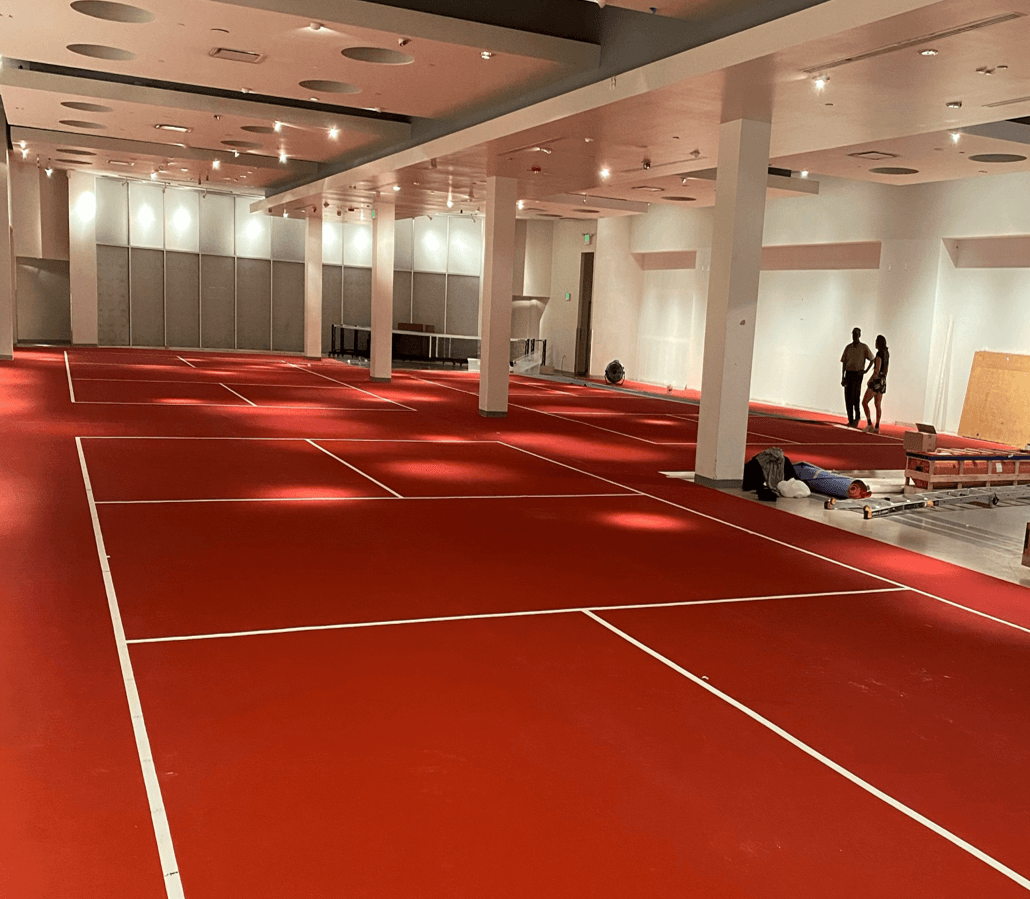
Facilities, clubs, and gyms. Clubs, rec centers, warehouses, and retail shells buy courts as inventory — one court or a floor of them. On ready concrete or a gym floor a single court still installs in under 30 minutes; full multi-court venues are completed in one to two days. Indoor installs over hardwood include floor protection, and the surface adheres only at the perimeter, so programming can change without a permanent commitment. A painted warehouse floor is a bet you can’t unwind; a roll-out floor is a bet you can reconfigure. Facility layouts and revenue planning live on the commercial page.
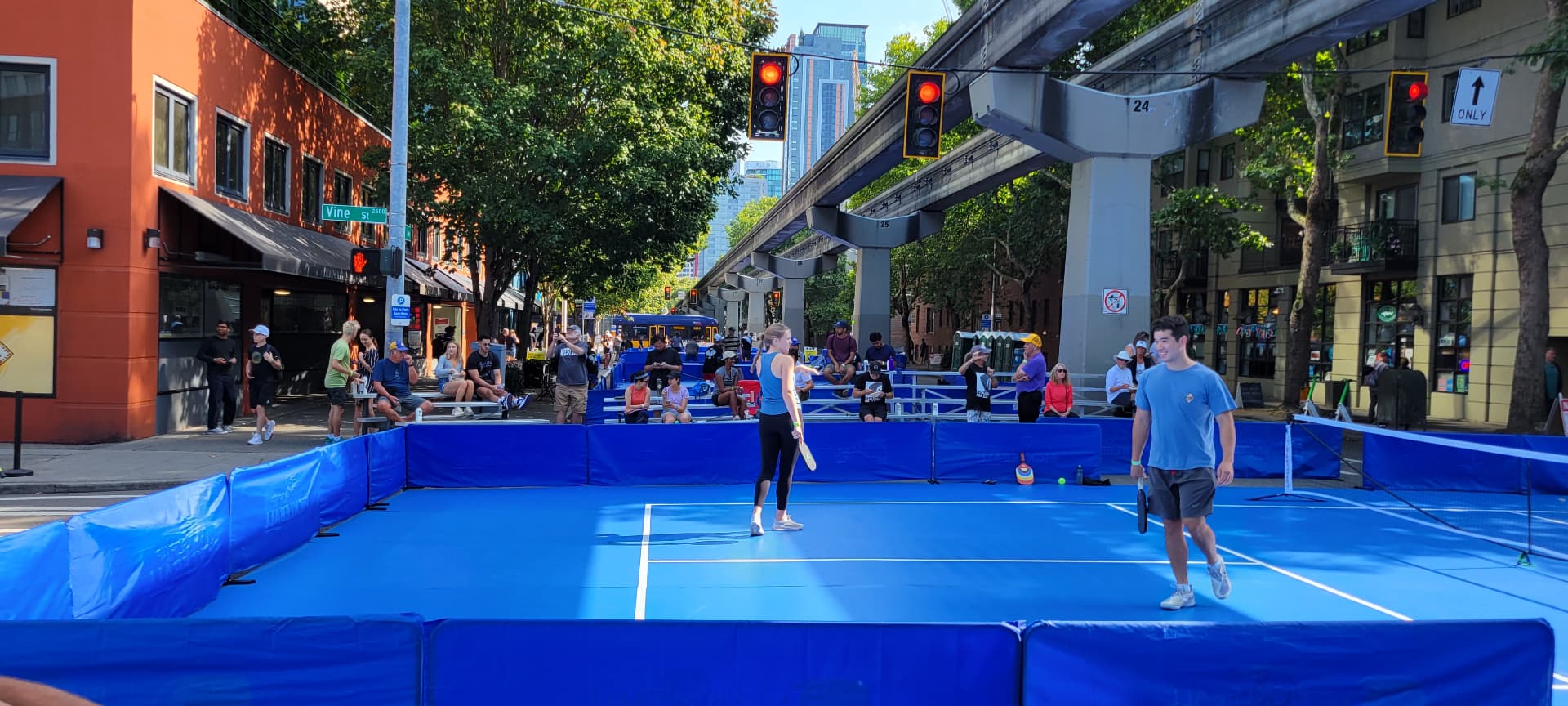
Events and pop-ups. Streets, convention floors, parking decks, and brand activations get tournament courts that vanish when you’re done. This is where the same class of surface used at championship venues really shows off — entire floors installed in a day or two, then rolled up and shipped to the next city. Event work is a rental with a start and end date, quoted on the events page rather than here.
Surfaces, grass, and PickleDeck
Roll-out courts install directly onto the surface family we publish site-wide when the base is ready: concrete, asphalt, hardwood gym floors, arena decking, carpet, parking structures. Flat, sound, and reasonably level is what matters — a good driveway, a gym floor, arena decking, a parking deck. Deep cracks through the play zone, severe slope, active drainage problems, or a heaving slab can change the answer, which is why photos beat a marketing paragraph every time.
Compatible surfaces
Soft grass, dirt, and rutted yards are a different problem — vinyl does not flatten soft ground, and USA Pickleball’s own guidance is blunt that grass won’t give a true bounce on its own. Those sites need PickleDeck, a modular sub-surface that creates the stable base first, then the same regulation roll-out surface goes on top. That’s a real additional system and it moves the quote — but it’s still not a poured slab and it’s still reversible. If you already have a sport pad or a sound patio big enough for the court plus runoff, you may not need it at all.
Footprint: the 20′×44′ rectangle plus runoff
Start with the rectangle that matters. The lined court is regulation 20′×44′ with pre-printed lines meeting USA Pickleball dimensions. Most sites shouldn’t stop at the painted lines alone — players need room behind the baselines and beside the sidelines so a wide ball doesn’t put someone into a fence, a planter, a parked car, or a wall. How much runoff you can spare depends on the space: a deep driveway apron behaves differently than a tight courtyard or a warehouse bay. Send paced-off length and width (or a phone photo with a tape measure in frame) and we’ll return an honest fit call — including a polite no when a space can’t support safe play. The full measuring walkthrough is in court space requirements.
Mid-read check: get a court quote
Know your approximate dimensions and surface type? Send them now — with a couple of photos if you have them. We typically respond within one business day with a real quote. There’s no public price list, because a flat driveway unroll, a four-court club build-out, and a grass yard that needs PickleDeck are not the same bill of materials.
- Length × width of the play area (rough is fine)
- Surface type — concrete, asphalt, gym floor, grass
- A few photos of the surface, slope, and obstacles
- Court count, and buy vs. rent preference
Plan your court
Straight answers before you buy or rent — what drives cost, how roll-out compares to pouring concrete, and how to convert a court you already have.
Pickleball court cost: roll-out quote factors
What sets your quote — court count, surface, sub-surface, buy vs rent, indoor/outdoor, and home vs facility vs event.
Read the guide →
Buying a roll-out court
How to buy the right court for a driveway, facility, or event — and what to ask before you do.
Read the guide →
Portable vs. permanent court
When a roll-out court beats pouring concrete, and the few cases where it doesn't.
Read the guide →
Tennis court to pickleball
Convert an existing tennis court to one or more regulation pickleball courts — no demolition.
Read the guide →
Temporary pickleball courts
Pop-up and seasonal courts that install in minutes and leave without a trace.
Read the guide →
HOA & community courts
Add courts to a community amenity space without a construction project or a special assessment.
Read the guide →
The same courts championships play on
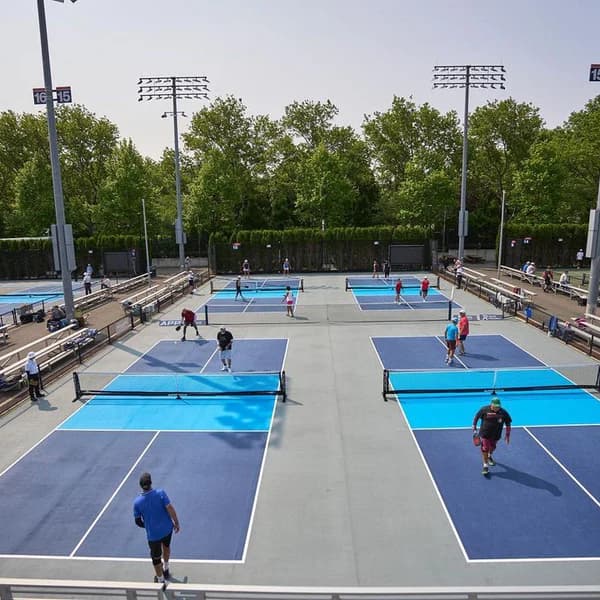
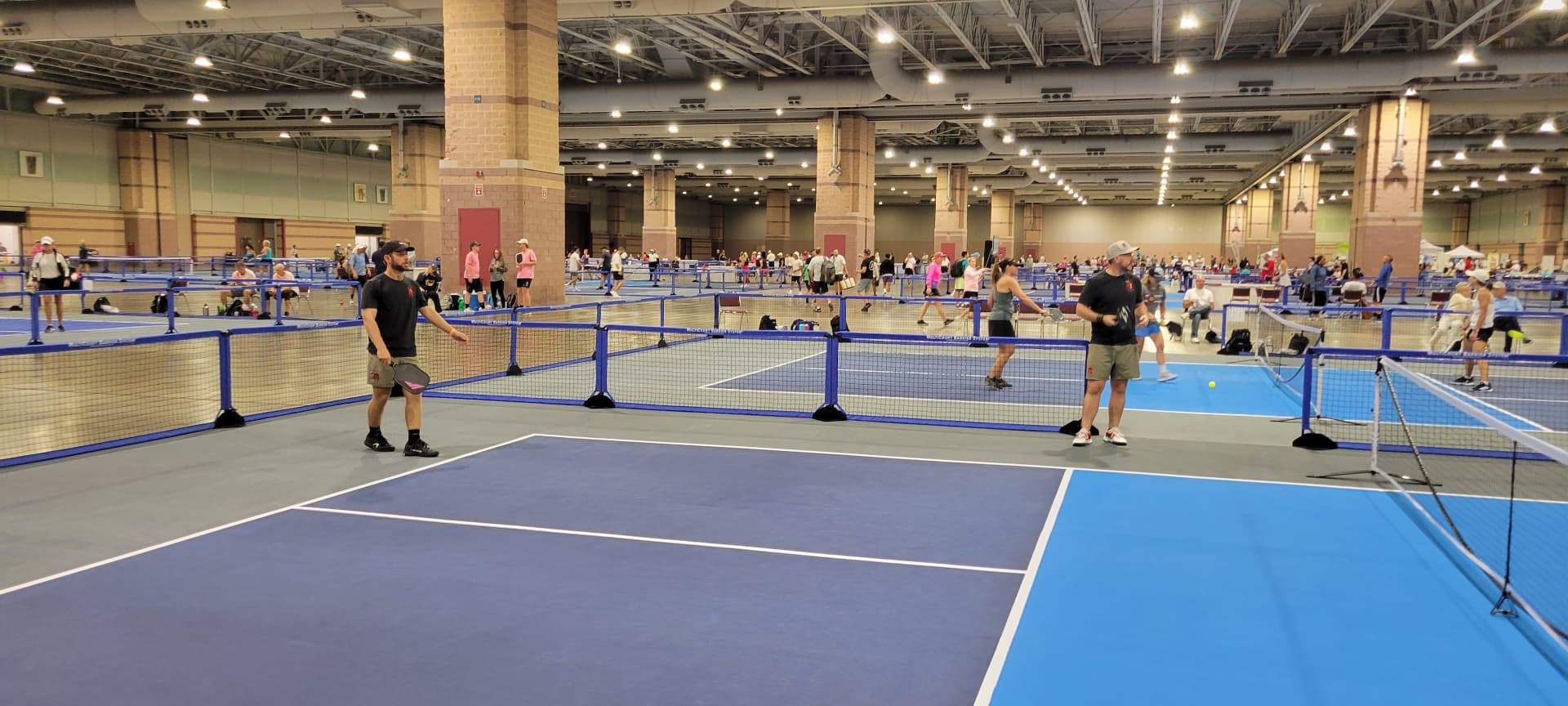
Our fulfillment partner is an Official Rollout Court Partner of USA Pickleball — the surfaces we sell and rent are the same class used to build out championship venues, from single exhibition courts to entire convention floors installed in one to two days.
That relationship speaks to the roll-out court product path and regulation-minded specs. It is not a blanket endorsement of every backyard, club, or event project, and we don’t stretch it into one. When we say a court is regulation, we mean the published 20′×44′ playing rectangle and pre-printed lines — not a custom certification badge invented for marketing.
Every court is reusable across seasons and venues: it rolls onto core tubes, stores in crates, and comes back out tournament-flat.
Read USA Pickleball’s announcement ↗Looking for something else?
Need a court for a specific date (festival, corporate event, pop-up)? That’s a rental — learn about events.
Soft grass, dirt, or uneven ground? Start with PickleDeck.
Warehouse, gym, or multi-court club? See the commercial page.
What to send for a quote
The fastest path to a useful reply is a short, complete package. Include approximate length × width of the play area, the surface type (concrete, asphalt, gym floor, grass, parking structure), a few photos showing slope, cracks, and nearby obstacles, your court count, and whether you want to buy or rent (or rent first). Add notes on nets, barriers, and any access constraints — gate width, stairs, no parking on install day, an upstairs garage. For events, include the dates.
You don’t need a survey drawing to start. A phone photo of the empty space plus paced-off dimensions is enough for a first-pass fit, and site assessment starts remotely. Pricing stays quote-only on purpose; for how the cost factors stack without fake dollar bands, see roll-out court cost factors. When you’re ready, the quote form below is the real site CTA — the same one used across contact, residential, and facility pages.
Roll-out court questions
How much does a roll-out pickleball court cost?
Pricing is quote-only. The number moves with court count, surface color, whether your site needs the PickleDeck sub-surface, net and barrier packages, and whether you're buying or renting — which is why we quote each project rather than publish a price list. A one-court driveway on ready concrete and a four-court club build-out are not the same SKU. Send your setup and we typically respond within one business day. Our roll-out court cost guide walks through each driver without inventing a dollar figure.
Is a roll-out court regulation size?
Yes — the lined court is regulation 20′ × 44′ with lines meeting USA Pickleball dimension and line specifications, pre-printed during manufacturing so there's no on-site painting. Comfortable play usually wants extra runoff behind the baselines and beside the sidelines; how much depends on your site. Send paced-off dimensions with your quote and we'll tell you honestly what fits.
What surfaces can it be installed over?
Concrete, asphalt, hardwood gym floors, arena decking, carpet, and parking structures all take the surface directly when they're flat and sound. For grass, dirt, or uneven ground, our PickleDeck modular sub-surface creates the flat, stable base first — vinyl doesn't flatten soft ground on its own.
How long does installation take?
A typical single court on a ready surface installs in under 30 minutes: the cushioned surface unrolls, aligns, seams, and adheres at the perimeter, then nets and barriers go up. Multi-court venues — like championship events — are typically completed in one to two days.
Should I buy or rent?
Buy when the court is staying — a home amenity, a club's everyday floor, a community space you want down season after season. Rent when the date is short or you want to validate demand first: event weekends, summer-only home use, and facility pilots that prove open-play revenue before a purchase. The same tournament-grade surface serves both; rental courts roll up onto core tubes for storage and reuse. If you're undecided, ask for both numbers side by side.
Does the ball bounce like on a real court?
The cushioned multi-layer vinyl surface is built to tournament ball-bounce consistency requirements — it's the same class of surface used at championship events. We don't publish invented lab numbers or proprietary bounce scores beyond that.
What is PickleDeck and when do I need it?
PickleDeck is a modular sub-surface that creates a flat, stable base over grass, dirt, or uneven ground before the roll-out court goes on top. You need it when your site isn't a ready slab or gym floor. If you already have flat concrete, asphalt, a sport pad, or a sound patio large enough for the court plus runoff, you likely don't need it. Send photos and we'll tell you which path your site is on.
Do you ship and install nationwide?
Courts can ship in the U.S. Installation is quoted per project — we don't claim blanket nationwide install coverage. Site assessment starts remotely from photos and dimensions, so the first pass costs you nothing but a few pictures and measurements.
I need courts for a specific event date — is that different?
Yes. A festival, corporate activation, or one-weekend tournament is a rental, not a purchase: courts go down, get played on, roll onto core tubes, and leave the venue without a trace. Those requests belong on our events page so the logistics and timeline are handled as a rental rather than a sale.
What should I send to get an accurate quote?
Approximate length × width of the play area, the surface type (concrete, asphalt, gym floor, grass, etc.), a few photos showing slope, cracks, and nearby obstacles, court count, buy vs. rent preference, and any access notes (gate width, stairs, no parking on install day). For events, include the dates. That package usually gets you a real quote in one business day with no follow-up round.
Get your court quote
Tell us where the court is going and we’ll price it for your exact setup — surface, sub-surface, nets, barriers, buy or rent. Typical response: one business day.
Prefer to keep reading first? Start with roll-out courts for sale, the residential and commercial pages, or the full guides hub.