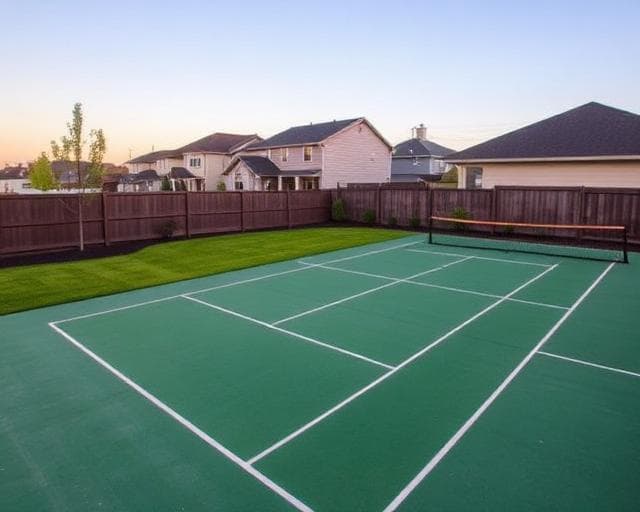
Who residential roll-out courts are for
This page is for homeowners and community decision-makers who want regulation pickleball without pouring a forever pad: driveway players who already have flat concrete or asphalt, backyard households whose grass needs a modular base first, HOA boards activating underused common space, families carving a court into a garage or barn, and multifamily managers adding a resident amenity that can come up if the property plan changes. If you are filling warehouse bays, gyms, or multi-court clubs, start on our commercial courts page instead. For one-day brand activations and private events, see event courts.
Grass or a sloped yard? Read about the PickleDeck sub-surface before you assume a direct roll-out will sit true.
What you get on every home court
Court size
20′ × 44′ regulation
Meets USA Pickleball dimensions and line specifications
Surface
Cushioned multi-layer vinyl
Tournament-legal bounce and traction
Lines
Pre-printed at manufacture
No on-site painting, ever
Install time
Under 30 minutes
Typical single court; multi-court venues in 1–2 days
These are the verified product facts we publish site-wide — court size, cushioned multi-layer vinyl, pre-printed lines, and install timing. We do not invent bounce ratings, warranty year-counts, or price bands beyond what is quoted for your site. Partnership context: courts are fulfilled by an Official Rollout Court Partner of USA Pickleball. That marks the product path, not a blanket endorsement of every backyard or HOA project.
Footprint, runoff, and what actually fits
Start with the rectangle that matters. A regulation pickleball court is 20′×44′ — that is the playing surface with pre-printed lines that meet USA Pickleball dimensions and line specifications. Most home sites should not stop at the painted lines alone. Players need room behind the baselines and beside the sidelines so a wide ball does not put someone into a fence, planter, garage door, or parked car. How much runoff you can spare depends on the lot: a deep driveway apron behaves differently than a tight courtyard between two wings of a house.
Commercial clubs often plan around a fuller 30′×60′ envelope per court. Home installs are more opportunistic — you work with the pad, driveway, or deck you already own. That is fine, as long as everyone is honest about the tradeoff. A court that fits the lines but leaves almost no runoff still plays; it just plays tighter, and beginners will feel the walls sooner. Send paced-off length and width (or a phone photo with a tape measure in frame) and we will return an honest fit call — including a polite no when the space cannot support safe play. For the detailed runoff breakdown, read pickleball court space requirements.
Orientation and neighbors matter more at home than in a warehouse bay. Morning sun in the server’s eyes, evening glare off a light-colored garage door, and ball noise toward a shared property line are ordinary residential planning questions. None of them automatically disqualify a site. They do change where you place the baselines, whether a windscreen or barrier helps, and whether a seasonal rent-first path is smarter than buying before you know how the neighbors react. We would rather adjust the layout than force a court into the loudest corner of the lot.
If your real question is driveway-specific — crown, expansion joints, apron width, parking conflict — start with the dedicated driveway pickleball court guide. Backyard households comparing lawn, patio, and sport-pad options should read backyard pickleball courts next.
Driveway, patio, grass, and PickleDeck
Residential roll-out courts install onto the same published surface family we use site-wide when the base is ready: concrete, asphalt, hardwood gym floors, arena decking, carpet, parking structures. At home, the most common ready bases are flat concrete driveways, asphalt driveways or sport pads, and finished garage or barn floors. Hardwood is less common in houses than in gyms, but the same floor-protection logic applies when you are putting a court over a finished indoor surface.
Compatible surfaces
Soft grass, rutted lawn, and uneven yard grade are a different problem. Vinyl does not magically flatten soft ground. Those sites need PickleDeck — a modular sub-surface that creates the stable base the court requires — before the roll-out surface goes down. That is not upselling; it is the difference between a true bounce and a court that telegraphs every divot. If you already poured a sport pad or have a sound patio large enough for the rectangle plus runoff, you may not need PickleDeck at all.
Protection and removal are part of the residential story. The court adheres only at the perimeter with double-sided tape. That bond keeps the surface stable under play, then releases so teardown does not peel driveway sealer or leave a ghost outline on a patio. For HOA boards and for households who rent their home, that removable profile is often the approval unlock — because the amenity does not permanently reassign the asset. Compare commitment profiles in portable vs. permanent pickleball courts.
What we will not do is invent friction coefficients, proprietary bounce scores, or “never damages any driveway” absolute claims. Photos of your slab, joints, crown, and any heaving tell us more about readiness than a marketing paragraph. Deep cracks through the play zone, severe slope, active drainage problems, or a landlord ban on any adhesive are the exceptions that change the quote — sometimes toward prep, sometimes toward PickleDeck, sometimes toward a polite no.
Buy vs. rent for homeowners and HOAs
The second decision after fit is commitment. A poured backyard hard court locks capital, landscaping, and property use before the first rally. A roll-out court changes that risk profile: because the surface removes cleanly, households can rent for a season to learn whether the driveway plays well, whether the kids stay interested, and whether neighbors tolerate the ball sound — then buy once the pattern is clear. Rent-to-validate is especially useful for first-time home players and for HOA pilots that need a reversible amenity story for the board packet.
Buying makes sense when the calendar is already full of family play, the pad is proven, and you want the court down as a lasting amenity (even though it remains physically removable). Renting makes sense for summer-only use, try-before-you-buy, short community pilots, and bridging until a larger landscape project finishes. Hybrid paths exist too: rent the first summer on the driveway, then buy when you know the orientation and runoff work. We do not publish rental day-rates or purchase SKUs on this page — every residential package is scoped to surface readiness, accessories, and logistics, then quoted.
If your real question is “should we pour instead?”, be honest about permanence. Pouring wins when you own the land, want a forever outdoor hard court, and accept construction timelines measured in weeks or months plus ongoing surface maintenance. Roll-out wins when speed, removability, HOA politics, rental-property constraints, or capital flexibility matter more than a permanent slab. Most residential inquiries we see land in the second camp — a ready driveway or a lawn that needs a modular base, not a capital campaign.
Mid-read check: get a home-court quote
Already know your approximate dimensions and surface type? Send them now — with a couple of photos if you have them. We typically respond within one business day with a real residential quote. No public price list, because a flat driveway unroll and a grass yard that needs PickleDeck are not the same bill of materials.
- Length × width of the play area
- Photos of the surface, slope, and nearby obstacles
- Surface type and buy vs. rent preference
- Nets, barriers, or HOA packet help if needed
HOA approval without overclaiming
Homeowner associations usually ask four questions: Is it permanent? Where does it sit on common vs. exclusive-use space? What does it do to parking, noise, and sightlines? Can it come up if the community changes its mind? A roll-out court answers the permanence question cleanly — perimeter adhesion and a designed teardown path mean the amenity is not a poured reassignment of the property. That does not mean every board says yes. It means you can bring an accurate product description instead of a vague “temporary court” hand-wave.
For community pads, treat the project like a small facility scope: measure the common area, confirm runoff away from sidewalks and parked cars, plan where nets and ball carts live, and decide whether the court is resident open-play only or also supports events. Deep dive for boards and managers: HOA community pickleball courts. Multifamily amenity teams with courtyards and podium pads should also see apartment-complex courts.
We can help you describe verified specs for an architectural-review packet. What we will not do is invent decibel guarantees, neighbor-satisfaction statistics, or “HOA approved nationwide” language. Your covenants, your parking map, and your board’s risk tolerance decide the outcome. The quote conversation is the right place to talk through a reversible pilot if the board wants proof before a longer commitment.
When NOT to force a residential roll-out
Honesty converts better than forced yeses. Do not force a roll-out court onto a driveway that is severely heaved, cracked through the play zone, or draining standing water after every rain. Do not claim a court fits when fences, HVAC pads, or the garage door swing eat the runoff. Do not treat soft lawn as “close enough” without PickleDeck or another real base. Do not put the baselines where every miss sends a ball into the street.
Shared-driveway and parking conflicts are another soft no. If the only pad is also the only place three cars must park every weeknight, design for a roll-up schedule or pick another surface. If a landlord or HOA forbids any adhesive — even perimeter tape — say so up front; we will tell you whether an alternate path is viable or whether the site is a poor fit. A declined quote that saves a bad install is still a good outcome.
What to send in a residential quote
The fastest path to a useful reply is a short, complete package. Include approximate length × width, a few photos of the surface and obstacles, the surface type, and whether you want to buy or rent (or rent first). Add notes on nets, barriers, and whether you need help with an HOA description. Access constraints (gate width, stairs, no parking on install day, upstairs garage) prevent surprises.
You do not need a survey drawing to start. A phone photo of the empty driveway plus paced-off dimensions is enough for a first-pass fit. If you are comparing the driveway against a backyard lawn option, send both — we would rather tell you which site earns a court than quote a weak one in isolation. Pricing stays quote-only on purpose; for how cost factors stack without fake dollar bands, see roll-out court cost factors.
How install, teardown, and care work at home
On a ready surface, a typical single court installs in under 30 minutes. The court unrolls, lines are already printed at manufacture (no on-site painting), and the perimeter is taped. Nets and any barriers follow. Home projects are usually one court, so the timeline is dominated by site readiness and access — not by multi-court venue choreography. If PickleDeck is in scope, that base work happens before the vinyl unroll.
Teardown reverses the sequence: release perimeter tape, roll the surface, store or ship, return the driveway or patio to ordinary use. Because adhesion is perimeter-only, households can reclaim parking for a holiday week or pull the court for winter without refinishing. That cycle — down for summer, up when the space is needed for something else — is exactly why residential buyers choose roll-out over permanent construction when the lot has to flex.
Aftercare is ordinary cleanliness, not a specialized chemistry set. Keep grit off the playing surface, follow the care guidance that ships with the court, and store rolls properly if they come up for a season. For routines and storage notes, see roll-out court maintenance. We will not invent lifespan year-counts or “never wears out” claims; wear depends on traffic, UV exposure outdoors, and how the court is stored between uses.
Partnership context — without overclaiming
PickleCourt USA courts are fulfilled by an Official Rollout Court Partner of USA Pickleball. Read the public announcement for the exact partnership language. That relationship speaks to the roll-out court product path and regulation-minded specs — it is not a blanket USA Pickleball endorsement of your particular backyard, driveway, or HOA amenity program. When we say courts meet regulation dimensions and line specifications, we mean the published 20′×44′ playing rectangle and pre-printed lines, not a custom certification badge invented for marketing.
If you need facility-scale courts for warehouses, gyms, or clubs, use the commercial path. If you need a one-off activation, use events. If soft ground is the blocker, look at PickleDeck. Everyone else with a home pad and a court goal — start the quote below.
Home court questions
How much space does a home pickleball court need?
The playing rectangle is regulation 20′ × 44′ with pre-printed lines that meet USA Pickleball dimensions. Comfortable home play usually wants extra runoff behind the baselines and beside the sidelines — how much depends on fences, landscaping, and how hard you play. Send paced-off dimensions or a quick sketch with your quote request and we will tell you honestly what fits.
Can I put a pickleball court on my driveway?
If the driveway is reasonably flat concrete or asphalt, yes — that is a core residential use case. The cushioned multi-layer vinyl surface rolls out, seams, and adheres at the perimeter; lines are already printed at manufacture. Severe heaving, deep cracks through the play zone, or a steep crown can change the answer — photos help us say so before you commit.
What about a court on grass or uneven ground?
Soft grass and uneven yards are not a direct roll-out surface. Those sites need a modular sub-surface first — PickleDeck — to create a flat, stable base. It is the same approach used when outdoor ground is the blocker rather than a ready slab. If you already have a sport pad or patio, you may not need it.
Do I have to buy, or can I rent for a season?
Both. Renting is popular for summer seasons, try-before-you-buy summers, and short HOA pilots. Buying makes sense when the court will stay down as a lasting home amenity. Your quote can cover both options if you are still deciding. We do not publish flat public prices because home packages are not one SKU.
Will it damage my driveway, patio, or garage floor?
The court adheres at the perimeter with double-sided tape and is designed to roll up without a trace. Indoor home installs include floor protection when the finish matters. Removability is part of why driveway, HOA, and rental-friendly setups work — you are not pouring a permanent pad into the property.
Will my HOA allow a residential roll-out court?
Many boards care most about permanence, noise, parking displacement, and whether the amenity can come up if plans change. A removable roll-out court is often easier to approve than a poured build because it does not permanently reassign common area. Bring photos, dimensions, and the removability story to the architectural review — we can help you describe the product facts accurately for that packet.
How much does a home pickleball court cost?
Pricing is quote-only. Surface readiness, whether you need PickleDeck, color package, nets and accessories, buy vs. rent, and access all move the number. Send dimensions, surface type, and a few photos — we respond with real figures, typically within one business day. We do not invent public dollar bands for residential installs.
What should I send with a residential quote request?
Approximate length × width of the play area, a few photos of the surface (and any slope or cracks), surface type (concrete, asphalt, grass, garage floor, etc.), buy vs. rent preference, and whether you need nets or help thinking through HOA approval. City and access notes (gate width, stairs, no driveway parking on install day) prevent surprises.
Price your home court
Send dimensions, surface type, and photos — we’ll come back with a real residential quote, typically within one business day. Prefer email? You can also reach us through contact.
Prefer to keep reading first? Browse buying a roll-out court, driveway courts, portable vs. permanent, or the full guides hub.