Modular court base system
PixleDeck: modular base for grass and uneven ground.
PixleDeck is the modular sub-surface system that levels soft outdoor ground so a regulation roll-out pickleball court can sit flat and stable — without pouring concrete or asphalt. Built for backyards, parks, HOAs, campuses, and outdoor venues that need real bounce on ground that is not already a pad.
Assess my site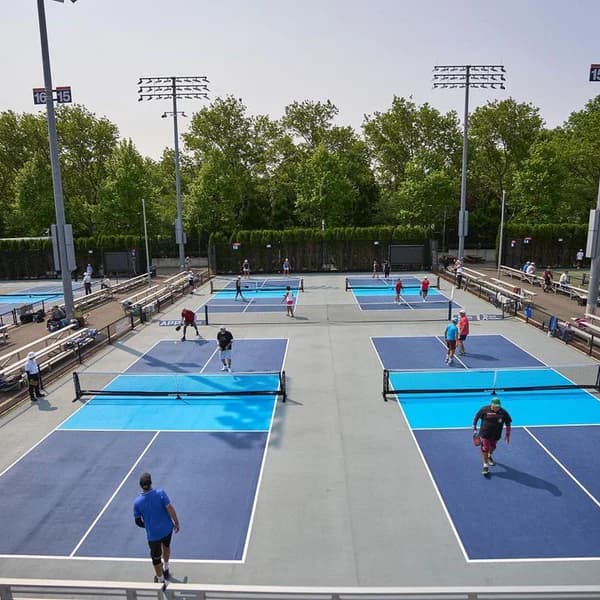
Where PixleDeck earns its keep
If the ground is already hard and flat, you probably do not need this page — start on residential, commercial, or events instead. PixleDeck is the grass-and-uneven path.
Backyards & lawns
When the yard is grass or gently uneven and you refuse a poured pad, PixleDeck builds the base first so the cushioned court can roll out true.
Home courts →Parks & green space
Keep the lawn when the court is not in use — modular base in for programming, out when the field needs to be a field again.
Temporary courts →HOA & multifamily lawns
Community greens that cannot spare a permanent asphalt pour can still host regulation play with a reversible base under the roll-out surface.
HOA court guide →Schools & campuses
Outdoor campus lawns and soft play fields that fail a bounce test become court-ready once the modular deck levels the ground.
School court guide →Senior living greens
Amenity lawns at active-adult and senior communities often need a base before any roll-out court — same product path as residential grass.
Senior living →Already flat? Skip it
Driveways, sport pads, patios, gym floors, and parking structures usually take the court directly — PixleDeck is for soft or uneven ground, not every site.
Space requirements →The court that sits on PixleDeck
Court size
20′ × 44′ regulation
Meets USA Pickleball dimensions and line specifications
Surface
Cushioned multi-layer vinyl
Tournament-legal bounce and traction
Lines
Pre-printed at manufacture
No on-site painting, ever
Install time
Under 30 minutes
Typical single court; multi-court venues in 1–2 days
PixleDeck does not replace these specs — it creates the base they need on soft ground. The playing surface is still cushioned multi-layer vinyl with lines printed at manufacture, the same product family used on concrete, asphalt, and gym floors.
Why soft ground fails a real court
Pickleball needs a true bounce and predictable traction. Grass looks inviting in photos and fails under a paddle game: the ball dies into soft turf, feet tear divots, and baselines wander as the ground gives. Dirt and mixed lawn behave the same way after a week of play or one wet weekend. That is not a branding opinion — it is why regulation outdoor courts live on hard, flat surfaces.
Property owners then face a blunt choice. Pour concrete or asphalt and accept a permanent rectangle, excavation, curing time, and a landscape that never fully returns. Or skip a real court and keep hitting on lawn with a bounce that teaches bad habits. PixleDeck is the third path: a modular sub-surface that levels the ground so the same tournament-grade roll-out court used indoors and on parking lots can sit true outdoors — without a pour.
The system is not magic fill for every terrain problem. Steep slopes, chronic drainage failures, and surfaces that heave every freeze-thaw cycle still need honesty at quote time. What PixleDeck does well is moderate unevenness and soft outdoor ground where a reversible base beats a forever pad — backyards, park programming zones, HOA greens, campus lawns, and senior-living amenity yards.
How the PixleDeck stack works: base, then court
Think in two layers. First, PixleDeck modules assemble into a flat, stable deck over grass or dirt. Second, the regulation cushioned vinyl court rolls out on that deck with pre-printed lines — no on-site painting. Nets and barriers finish the playable rectangle. Players experience the upper court the same way they would on a ready concrete pad; the modular deck is doing the quiet work underneath.
Configuration follows the site, not a one-size kit photo. Ground condition, slope, drainage paths, and how many courts you want all shape the base layout. That is why we ask for photos and rough dimensions before quoting: two lawns that look similar from the street can need very different base work once you walk the grade with a level.
When the court needs to leave, the reverse order applies — surface up, then base up — and the ground can return to lawn or park use. Leave everything down and you have an outdoor amenity that never required a poured slab. That flexibility is the product job, not a side feature.
PixleDeck vs. permanent concrete courts
A poured concrete or asphalt court is permanent, requires excavation and curing time, and locks the property into a single rectangular footprint forever. PixleDeck offers the inverse: modular assembly, no excavation, reversibility, and the same regulation play surface on top. For property owners who want a real pickleball court but refuse to sacrifice landscape flexibility, PixleDeck is the only path that delivers both.
Concrete courts excel when permanence is the goal and the site is already flat. PixleDeck excels when soft ground is the blocker and reversibility is the requirement. Choose based on your ground condition and your long-term vision for the space — not on cost alone, which varies too much by site to compare in the abstract.
PixleDeck installation and timeline
On a ready hard surface, a single roll-out court typically goes down in under 30 minutes. PixleDeck adds base assembly before that clock starts. Total calendar time depends on site access, weather, court count, and how much barrier or netting work rides with the install. We quote that timeline with the same site package — not as a universal marketing number.
After install you choose permanence by behavior, not by pouring. Leave the system down for a season or for years as a lasting outdoor amenity. Schedule removal when the lawn needs to be a lawn again, when a park program ends, or when an HOA wants the green back for another use. The ground is not trapped under a cured slab either way.
Maintenance stays practical: keep the playing surface clean, watch for debris at module seams after storms, and flag any settling you notice after an extreme wet or freeze period. Soft-ground installs deserve a post-weather eye the same way outdoor asphalt courts do — early photos beat late surprises.
Why PixleDeck beats grass-only courts
Many property owners ask whether they can simply paint lines on grass and call it a court. The answer is no — not for any serious play. Grass courts fail because the surface itself is the problem, not the markings. A painted line on turf does not fix the compression, divot, and dead-ball issues that make grass unplayable for regulation pickleball. PixleDeck solves the root cause by replacing the soft ground with a modular hard base, then rolling out a proper court on top. The result is a real court that plays true, not a lawn with optimistic lines.
This distinction matters for player experience and property liability. A grass court teaches bad footwork and ball control because the bounce is unpredictable. Players also tear the turf, creating maintenance headaches and safety hazards. PixleDeck eliminates both problems by creating the flat, hard surface that regulation play requires — and that USA Pickleball standards demand.
PixleDeck for multi-court layouts
Parks, HOAs, and campuses often want multiple courts to maximize programming and player throughput. PixleDeck scales to multi-court configurations without requiring separate poured pads for each rectangle. The modular base assembles into a unified platform that supports two, three, or more courts side by side, with proper spacing for player movement and spectator sightlines. This approach saves time, cost, and landscape disruption compared to pouring multiple concrete slabs.
Multi-court PixleDeck layouts also preserve the reversibility advantage. When a park program ends or an HOA wants the green back, the entire base comes up as a unit, and the ground returns to its original use. That flexibility is impossible with poured concrete and is a major reason why institutional buyers choose PixleDeck for soft-ground sites.
PixleDeck modular system advantages
The modular design of PixleDeck offers distinct advantages over traditional poured-concrete court installations. Each module interlocks with precision, creating a unified playing platform that distributes weight evenly across soft ground. Unlike concrete, which requires weeks to cure and permanent site commitment, PixleDeck modules can be deployed, adjusted, and removed on your timeline. This flexibility makes PixleDeck the preferred choice for property owners who want a real regulation court without sacrificing future land use options.
The modular approach also simplifies logistics. Modules arrive ready to assemble — no excavation equipment, no concrete trucks, no curing delays. Installation crews can work around weather windows and site access constraints that would halt a poured pad. For multi-court projects, the modular system scales linearly: add courts by adding modules, not by multiplying concrete pours and curing timelines.
Seasonal flexibility is another key advantage. Parks and HOAs can deploy PixleDeck for league season, then remove it when the green is needed for other programming. Homeowners can leave the system down year-round as a permanent amenity, or schedule removal if life circumstances change. That reversibility is impossible with concrete and is a primary reason why soft-ground sites choose PixleDeck over traditional court construction.
PixleDeck expert assessment process
A useful PixleDeck quote starts with the ground, not a catalog SKU. We look at usable rectangle size versus the regulation 20′ × 44′ regulation court plus runoff, how much the grade changes across that footprint, whether water sits after rain, and what access path equipment and modules will use. Tree roots, irrigation heads, play structures, and fence lines that clip the runoff zone all show up in photos if you take them from a few angles.
Slope honesty matters more than enthusiasm. Gentle crowning that a modular deck can level is normal backyard work. A hillside that wants retaining walls is a construction project we will not dress up as a weekend unroll. Drainage that sheets across the proposed court will still sheet after modules go down unless the water plan changes — PixleDeck levels play; it does not redesign your yard's hydrology.
Court count multiplies base scope. One backyard court is a contained job. Two or three outdoor courts for an HOA or campus mean more modules, more layout planning, and more attention to how players move between courts. Tell us the programming goal (family play, league nights, resident amenity) so the base quote matches how the space will actually be used — not just the minimum rectangle that fits on a napkin sketch.
Pricing honesty for PixleDeck
There is no published PixleDeck price list on this site, and we will not invent one. Soft ground vs. nearly flat dirt, one court vs. three, buy vs. rent, color package, nets, barriers, and travel/access all move the quote. A flat driveway unroll and a grass yard that needs a full modular base are not the same bill — treating them like they are would be dishonest to both buyers.
What you get from a quote request is a real number for your described site, typically within one business day when photos and dimensions are clear. If PixleDeck is the wrong tool — already-flat concrete, a slope that needs civil work, or an event that only needs a street rental — we will say so and point you at the right page instead of padding a grass quote you should never have received.
For the cost drivers that apply once a base is decided, the roll-out court cost guide explains quote factors without fake dollar bands. Pair it with this page when your blocker is soft ground rather than “how much is a court in the abstract.”
Surfaces that skip PixleDeck
Our roll-out courts install directly on hard, stable bases. The surfaces we already support without a grass deck include:
If your site is already on that list and reasonably flat, start on the matching path — home, facility, or event — instead of forcing PixleDeck into a job it is not for. A cracked or heaved hard surface may need prep; that is still a different scope than building a modular base over lawn. We would rather redirect you early than sell a grass system onto a driveway that only needs an unroll.
Outdoor event planners on asphalt streets and parking lots usually stay on the events rental path. Grass festival greens and soft park fields are where PixleDeck enters the conversation. Same company, different base problem.
PixleDeck ground preparation and site readiness
Before PixleDeck modules arrive, the site needs honest assessment of what prep work is required. Soft ground that is relatively level — gentle slopes under 5% — typically needs only debris removal and rough grading. Steeper terrain, poor drainage, or heavy vegetation may require additional earthwork that changes the project scope and timeline. We evaluate these factors during the quote process so you know exactly what to expect before installation begins.
Site access is equally important. Equipment and modules need a clear path to the court location. Narrow gates, tight corners, or limited parking can add time and cost to delivery and assembly. Communicating these constraints upfront helps us plan the most efficient installation sequence and avoid surprises on install day.
Utilities buried underground — irrigation lines, electrical conduit, gas lines — must be marked before any ground work begins. PixleDeck installation does not require deep excavation, but surface-level utilities should be identified and protected. Always call your local utility locating service before work starts, regardless of how shallow the modular base appears to be.
PixleDeck performance in different climates
PixleDeck performs reliably across diverse climates, but regional weather patterns do influence long-term behavior. In freeze-thaw zones, monitor the base after winter for any settling caused by ground heave. Wet climates with high rainfall require attention to drainage — PixleDeck does not change your yard's hydrology, so standing water before installation will still be a concern afterward. Arid regions with minimal precipitation typically see the most stable performance, as ground movement is minimal.
Seasonal deployment and removal is common in climates with extreme winters or monsoon seasons. Many property owners in these regions install PixleDeck for their primary playing season, then remove it when weather becomes severe. This approach protects the modular base from unnecessary stress and extends the system's useful life. We can advise on seasonal timing based on your specific location and climate profile.
PixleDeck vs. other soft-ground solutions
PixleDeck is not the only way to address soft ground, but it is the only modular, reversible path that delivers a regulation court without pouring concrete. Some property owners consider sand base systems, rubber mulch, or compacted gravel — all of which fail to meet USA Pickleball bounce and traction standards. Others explore temporary court rentals on grass, which sidestep the base problem but deliver substandard play. PixleDeck bridges the gap by providing a real court on a real base that you can remove when you choose.
The key distinction is permanence by choice, not by default. Concrete locks you in. Grass courts fail. PixleDeck lets you decide: leave it down as a lasting amenity, or remove it when the space is needed for something else. That flexibility, combined with regulation court performance, is why PixleDeck is the preferred solution for parks, HOAs, and homeowners who want both options.
PixleDeck for residential and commercial use
PixleDeck serves both residential homeowners and commercial property managers who need a regulation pickleball court on soft ground. For homeowners, PixleDeck transforms a backyard lawn into a tournament-ready court without the permanence of a concrete pad. For commercial operators — parks, HOAs, senior communities, and schools — PixleDeck enables flexible programming that adapts to seasonal demand and changing facility needs.
The modular system scales seamlessly from a single backyard court to multi-court layouts that serve dozens of players. Whether you are building a home amenity or a community asset, PixleDeck provides the same regulation court performance and reversibility. The difference is scope: residential projects typically involve one court and modest base work, while commercial installations may require multiple courts, enhanced drainage, and coordinated access planning.
Both residential and commercial buyers appreciate PixleDeck's honesty about site limitations. We assess your ground condition and tell you clearly whether PixleDeck is the right fit or whether another approach makes more sense. That transparency builds trust and ensures you invest in a solution that actually works for your property.
PixleDeck: The reversible court base for soft ground
PixleDeck represents a fundamental shift in how property owners approach outdoor pickleball courts. Instead of choosing between a permanent concrete pad and a substandard grass court, PixleDeck offers a third option: a modular, reversible base that delivers regulation play without sacrificing landscape flexibility. This innovation has made PixleDeck the preferred solution for backyards, parks, HOAs, and schools across North America.
The system's success lies in its honesty. PixleDeck is not a universal solution — it is purpose-built for soft ground and moderate unevenness. Sites with steep slopes, chronic drainage problems, or already-flat surfaces are better served by other approaches. But for the majority of property owners who want a real court on grass or dirt, PixleDeck is the only path that combines regulation performance, reversibility, and practical installation.
When you choose PixleDeck, you are choosing permanence by behavior, not by default. Leave the system down for years as a lasting outdoor amenity, or remove it when the space is needed for something else. That flexibility, combined with the same tournament-grade court used on concrete and gym floors, is why PixleDeck has become the standard for soft-ground pickleball installations.
PixleDeck: Modular base for grass courts that work
PixleDeck is the only modular base system designed specifically for grass and uneven ground pickleball courts. Unlike temporary grass courts that fail under regulation play, PixleDeck creates a hard, flat foundation that supports the same tournament-grade roll-out court used on concrete and gym floors. This distinction is critical: PixleDeck is not a grass court solution — it is a base that eliminates grass as a playing surface problem.
For property owners who want a real pickleball court on soft ground without pouring concrete, PixleDeck is the only honest path. The modular design allows for flexible configurations, reversible installation, and multi-court scaling. Whether you are building a backyard court, a park amenity, or a campus facility, PixleDeck delivers regulation performance with the flexibility that concrete cannot match.
The PixleDeck advantage is permanence by choice. Leave the system down as a lasting outdoor amenity, or remove it when the space is needed for something else. That flexibility, combined with real court performance and honest site assessment, is why PixleDeck has become the standard for soft-ground pickleball installations across residential, commercial, and institutional properties.
Related paths before you request a quote
- Residential / backyard courts — when the home site may already have a pad, or may need PixleDeck first.
- Commercial & facility courts — gyms, warehouses, clubs, and indoor/outdoor facility layouts on hard surfaces.
- Event & pop-up rentals — streets, lots, and venues scoped to a date window and teardown.
- Backyard pickleball court guide — planning the home rectangle, runoff, and neighbors before you buy.
- Portable vs. permanent — when reversibility is the decision, not just the surface type.
- Roll-out court overview — product family, USA Pickleball partnership context, and buy vs. rent framing.
Get a PixleDeck site assessment
Choose “Grass or uneven ground” as the surface and tell us residential, commercial, event, or HOA. Photos of the grade and a rough length × width beat a long email every time. We reply with whether PixleDeck fits and a real quote — typically within one business day.
- • Quote-only — no invented public price list
- • Honest no when the slope or drainage will not work
- • Same regulation court specs once the base is true
PixleDeck questions
What is PixleDeck and how does it work?
PixleDeck is a modular sub-surface system that levels grass, dirt, and uneven ground so a regulation roll-out pickleball court can sit on a flat, stable base. It is the path for outdoor sites that do not already have concrete, asphalt, or another hard playing surface. The cushioned vinyl court still rolls out on top with pre-printed lines — PixleDeck is the foundation layer, not a substitute for the court surface itself. The modular design allows for flexible configurations that match your site's specific ground conditions and court count.
Can you put a pickleball court directly on grass?
Not if you want a true bounce. Soft grass and dirt compress under play and will not hold regulation rebound. USA Pickleball court guidance assumes a hard, flat playing surface for fair bounce and traction. PixleDeck exists specifically to create that hard, flat base over soft ground so the same tournament-grade roll-out court used on concrete or gym floors can perform outdoors without a poured pad. Without PixleDeck, grass courts fail because the surface itself is the problem, not the markings.
Is a PixleDeck install permanent or removable?
It can stay down season after season like a lasting amenity, or come up so the ground returns to lawn or park use. Nothing is poured or paved as part of the PixleDeck path. That reversibility is why parks, HOAs, and homeowners choose it when a forever asphalt rectangle is a non-starter. You choose permanence by behavior, not by pouring — leave the system down for years as a lasting outdoor amenity, or schedule removal when the lawn needs to be a lawn again.
Does PixleDeck work on a sloped or uneven yard?
Moderate unevenness is what the system is built to address. Steep grades, drainage swales, tree roots that keep heaving, or sites that pond after rain may need prep first — or may not be honest candidates. Send photos, a rough slope read, and dimensions with your quote request; we will say clearly whether PixleDeck fits or whether another surface path is smarter. Slope honesty matters more than enthusiasm — a hillside that wants retaining walls is a construction project we will not dress up as a weekend unroll.
How long does a PixleDeck installation take?
The roll-out court itself typically installs in under 30 minutes on a ready base. PixleDeck base work happens first and is scoped to your ground condition, court count, and access — so total time is quoted per site rather than sold as a single universal number. Multi-court outdoor layouts take longer than a single backyard court for the same reason commercial multi-court builds do. Total calendar time depends on site access, weather, court count, and how much barrier or netting work rides with the install.
How much does PixleDeck cost?
Pricing is quote-only. Ground condition, slope, court count, color package, nets and barriers, buy vs. rent, and access all change the number. We do not publish invented dollar bands for PixleDeck or for the court that sits on it. Describe the site and send photos — you get real figures, typically within one business day. There is no published PixleDeck price list because soft ground vs. nearly flat dirt, one court vs. three, and other variables move the quote significantly.
Do I need PixleDeck if I already have a driveway or patio?
Usually no. Flat concrete, asphalt, sport pads, and many patios take the cushioned roll-out court directly. PixleDeck is for grass, dirt, and uneven outdoor ground. If your hard surface is badly heaved or cracked, you may need prep — that is a different conversation than adding a modular grass base. Our roll-out courts install directly on hard, stable bases without requiring a grass deck.
Is the court on top still regulation size and tournament-grade?
Yes. The playing surface is the same regulation 20′ × 44′ cushioned multi-layer vinyl used on our other installs, with lines pre-printed at manufacture. PixleDeck does not change court dimensions or line specs — it creates the base those dimensions need when the ground alone cannot. Players experience the upper court the same way they would on a ready concrete pad; the modular deck is doing the quiet work underneath.
Find out if your site works
Choose “Grass or uneven ground” as your surface and describe the site — slope, ground condition, rough dimensions, and how many courts you want. We assess it and quote the full PixleDeck + court setup without invented catalog pricing.
Already on concrete, asphalt, or a gym floor? Skip PixleDeck and go straight to residential, commercial, or contact.