Roll out / rollout / roll-up court sales · Buy a court
Roll out pickleball courts for sale
Buy a roll out pickleball court / pickleball rollout court for home or commercial pickleball courts — the portable regulation surface searchers mean by rollout, roll-out, or roll-up. Cushioned multi-layer vinyl, factory-printed 20′×44′ lines, typical ready-surface install under 30 minutes. Custom-quoted. No invented price list.
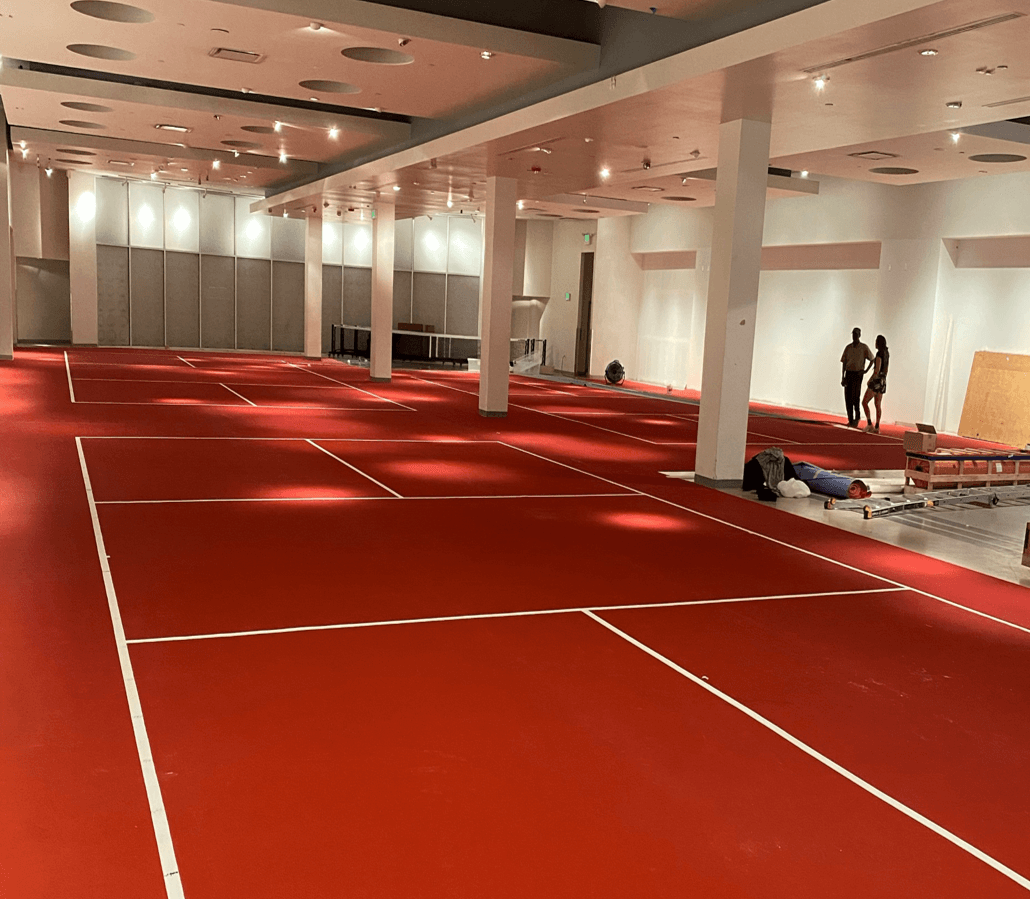
Court size
20′ × 44′ regulation
Meets USA Pickleball dimensions and line specifications
Surface
Cushioned multi-layer vinyl
Tournament-legal bounce and traction
Lines
Pre-printed at manufacture
No on-site painting, ever
Install time
Under 30 minutes
Typical single court; multi-court venues in 1–2 days
Updated · First published
The short answer
A roll out pickleball court (also called a pickleball rollout court, roll-out court, or roll up pickleball court) is a finished, regulation playing surface you buy — not a construction project and not a weekend rental. The lined court is 20′×44′, the size set by USA Pickleball's Official Rulebook. Lines are pre-printed. The surface is cushioned multi-layer vinyl. On a ready slab or gym floor it typically installs in under 30 minutes (previously published on this page). You get a quote for your court count, color, sub-surface, nets and barriers — we do not publish a price, because a driveway buy and a four-court club buy are not the same product.
Roll out, rollout, roll-out, roll up — same court, different searches
Buyers do not all type the same words. People looking to purchase search for pickleball rollout court, roll out pickleball courts, roll out pickleball court, pickleball roll out court, and roll up pickleball court. Those are not five products. They are five ways of naming one purchase: a regulation vinyl court that unrolls onto a suitable base, plays with factory-printed lines, and can later roll onto core tubes when you need the space back.
Roll out / rollout / roll-out describe installation — the surface leaves the crate on core tubes and becomes a court. Roll up describes the reverse motion — removal and storage — which is why people shopping for a portable asset use that phrase even when they plan to leave the court down most of the year. If your intent is a dated weekend, festival, or pop-up, stop and use /events or read the temporary pickleball court guide. This URL is for buyers who want to own the court.
We will not invent thickness specs, bounce lab numbers, or a price tag to win those queries. What we will do is answer the buyer questions those searches imply: what arrives, what size is official, what ground you need, how buy differs from rent, and how to get a real quote. The buy-roll-out guide and the cost-factor guide go deeper on purchase path and quote drivers; this page is the product-and-sale home for the query cluster.
What a buyer of a roll-out court actually gets
When you buy a roll out pickleball court from this page, you are purchasing a finished playing surface — not a paint job and not a bag of plastic tiles. The surface is the same class of cushioned multi-layer vinyl previously published across this site: tournament-spec lines printed at manufacture, regulation 20′×44′ lined court, compatible with concrete, asphalt, gym floors, arena decking, parking structures, carpet, and — over grass or uneven ground — the PickleDeck modular sub-surface. A typical single court on a ready surface installs in under 30 minutes; multi-court venues are previously published as completing in one to two days.
Ownership is the point of the sale. Leave the court perimeter-adhered and it is your everyday home, HOA, gym, or club surface. Need the space for a different program later? The same court rolls up. That is the asset buyers comparing a pickleball rollout court to a poured-and-painted slab are usually paying for — reversibility without giving up a true playing surface. Deeper buy-versus-build framing lives in the portable vs. permanent guide.
- Home / driveway buyers — one court on existing concrete or asphalt, or PickleDeck over lawn. Plan on residential.
- Club / gym / warehouse buyers — one court or a floor of them, often after a rental test. Plan on commercial.
- Date-only needs — rent, do not force a buy. Plan on events.
Portable pickleball rollout court — what that search actually buys
Searchers who type pickleball rollout court, roll out pickleball court, or portable pickleball court are usually comparing three ideas at once: a court that is regulation size, a court that does not require a poured slab, and a court that can leave the site later. This page answers that cluster as a purchase — not as a weekend rental and not as a DIY tile kit.
A purchased pickleball rollout court is portable because the finished surface ships on core tubes, unrolls onto a suitable hard base, and can later roll up for storage or a move. It is still a true playing surface while it is down: cushioned multi-layer vinyl, factory-printed 20′×44′ lines, perimeter-adhered when you want it to stay. That is different from snap-together plastic tiles (seams and a harder feel) and different from painting an existing slab (permanent conversion, cure time, no take-back). If your date is short — festival, activation, one weekend — use /events or the temporary court guide instead of forcing a buy.
Fit still comes first. USA Pickleball sets the lined court at 20′×44′ and recommends at least 30′×60′ total playing space (34′×64′ preferred for new construction and tournament play). Measure the clear rectangle you actually own — driveway, gym floor, warehouse bay, plaza pad — before you ask for a price. The space-requirements guide and the driveway court guide walk those measurements for home sites; commercial pads follow the same geometry.
Roll out vs rollout vs roll-up spelling
Hyphenation does not change the product. Roll out pickleball court, pickleball rollout court, roll-out pickleball court, and roll up pickleball court all point at the same vinyl system on this site. We keep those phrases in the title and body so Google sees the match; we do not invent five SKUs to chase five spellings. The buy URL stays /roll-out-pickleball-court.
Where portable rollout courts land most often
- Driveways and home slabs — one court on ready concrete or asphalt, or PickleDeck over lawn. See driveway courts.
- Office campuses and commercial floors — amenity or wellness programming without a permanent pour. See office-campus courts.
- Retail plazas and shopping centers — weekend activations or lifestyle amenities on pads that still need cars. See shopping-center courts.
Every path above is still quote-only. We will not invent a portable-court package price, a bounce lab number, or a year-count warranty figure this page has never published. Tell us the setting, surface, dimensions, and court count — photos help — and we return a buy quote, typically within one business day.
Buyer decision: buy vs rent, indoor vs outdoor, footprint
Most people who land on roll out pickleball court or pickleball rollout court are mid-decision, not mid-checkout. Three forks decide whether a quote is useful: own vs rent, indoor vs outdoor base, and whether your clear rectangle actually fits a regulation court. Work those before you ask for a number — we still custom-quote; we will not invent a package price to shortcut the geometry.
Buy vs rent (same surface, different job)
Buy when the court is staying on your driveway, HOA pad, gym floor, warehouse bay, or campus amenity calendar — and you want a portable asset you can leave perimeter-adhered or later roll onto core tubes. Rent when the need is a dated weekend, festival, corporate activation, or a short demand test. Rentals and event leave-downs belong on /events and the temporary pickleball court guide. The deeper comparison lives in buy vs rent a roll-out court. If finance is still deciding, put both intents in one quote brief — we will not invent a “starter package” dollar figure to force the choice.
Indoor vs outdoor (same class of surface, different site work)
The sold court is the same class of cushioned multi-layer vinyl with factory-printed regulation lines whether it lands indoors or outdoors. What changes is the base and the protection plan:
- Indoor — gym floors, arena decking, warehouse slabs, carpet over a stable floor. Hardwood and finished floors get floor protection before roll-out. Climate is controlled; UV and drainage are not the story.
- Outdoor on hard pad — concrete, asphalt, parking structures, plaza pads. Orientation and sun still matter for play quality (USA Pickleball prefers north–south outdoor courts). Drainage and slope show up in the site brief.
- Outdoor on soft ground — grass and dirt do not give a true bounce on their own; USA Pickleball says so. The previously published answer on this site is PickleDeck first, then the same vinyl surface. That is a real additional system and it moves the quote.
We do not claim every outdoor pad is a DIY kit, and we do not invent nationwide install coverage. Photos and clear dimensions decide whether your site is a direct roll-out or a sub-surface conversation.
Footprint: 20′×44′ lined, 30′×60′ minimum, 34′×64′ preferred
Court size is not a marketing choice. The USA Pickleball Official Rulebook sets the lined court at 20 feet (6.10 m) wide by 44 feet (13.41 m) long for singles and doubles. The same rulebook’s recommended total playing surface is at least 30′×60′; 34′×64′ is preferred for new construction and tournament play. Those figures are official — we cite them; we do not invent a private “tournament plus” size.
Measure the clear rectangle you control after cars, walls, poles, doors, and HOA setbacks — not just the lined 20′×44′. If the pad is tighter, say so; skinny and mini formats (previously published on this page) exist for garages and side yards. Walk the corners with tape before you ask for a price. The space-requirements guide and the driveway court guide walk home-site measuring in more detail.
| Decision | Choose buy on this page when… | Choose a different path when… |
|---|---|---|
| Own vs rent | Court stays on your calendar; you want a portable asset you can leave down or roll up later. | Dated weekend / festival / activation — use /events or the temporary-court guide. |
| Indoor vs outdoor | You have a hard, reasonably flat base (or will add PickleDeck over soft ground) and can share photos. | You only need a one-day leave-down on a venue floor with a hard teardown window — still often a rent. |
| Footprint | Clear rectangle meets ~30′×60′ (34′×64′ preferred) or you accept skinny/mini formats honestly. | Pad cannot fit runoff and you need a painted permanent conversion instead — different product. |
Ready for a site-specific buy quote? Include setting, indoor/outdoor, clear dimensions, court count, surface photos, and buy (not rent). Quotes typically return within one business day — previously published on this page. No invented price list.
Commercial pickleball courts: buy a roll-out floor for facilities
Searchers who type commercial pickleball courts alongside pickleball rollout court or roll out pickleball courts are usually facility buyers — not weekend renters. Gyms, warehouses, clubs, office campuses, multi-court HOAs, retail plazas, hotels, and venue operators want regulation play on an existing hard floor without opening a permanent construction project. That is a purchase on this page: the same class of cushioned multi-layer vinyl with factory-printed 20′×44′ lines, quoted for court count, barriers, and your actual pad.
Commercial buys differ from a single driveway in three practical ways. First, court count — operators often start with one court to prove demand, then add a second and third with the same surface system so programming and inventory stay consistent. Second, side-by-side barriers and runoff — USA Pickleball's recommended total playing space is at least 30′×60′ per court (34′×64′ preferred for new construction and tournament play), so multi-court layouts need honest geometry, not a marketing floor plan. Third, reconfiguration — a painted warehouse bay is a bet you cannot unwind; a purchased roll-out floor can be reduced, re-laid, or rolled onto core tubes when membership mix or lease terms change.
Rollout vs permanent for commercial sites
Buy roll-out / rollout when the pad is already suitable (gym floor, warehouse slab, parking structure, plaza) and you want a portable asset that can stay perimeter-adhered or leave later. Pour and paint only when the space is dedicated forever and leadership accepts a permanent conversion. Soft ground still needs a hard base first — on this site that is PickleDeck before the same vinyl surface. Deeper framing lives in the portable vs. permanent guide and the commercial pickleball courts guide.
When commercial buyers should rent instead
A dated festival, one-weekend activation, or demand test with a hard teardown window is still a rental — same surface class, different job. Those quotes belong on /events and the temporary pickleball court guide. Operators who later want the courts in inventory come back here for a buy quote. If finance is comparing both paths, put buy and rent on one brief; we will not invent a starter-package dollar figure to force the choice. Cost drivers without invented prices are walked in the roll-out court cost guide.
Recurring venue programming (travel hubs, waterfront, plazas)
Some commercial buyers are not building a traditional club — they own or operate a venue that runs pickleball as recurring amenity or activation inventory. Travel hubs, cruise-port plazas, and waterfront decks often rent for a single date, then buy once the calendar repeats. Peer planning notes (still quote-only) live in the airport & travel hub court guide and the cruise port & waterfront court guide. Facility layouts and programming notes for gyms, warehouses, and clubs live on /commercial.
| Commercial buyer type | Usually buys here when… | Usually rents (/events) when… |
|---|---|---|
| Gym / warehouse / club | Courts stay on the membership or open-play calendar; you may reconfigure later. | Short demand test before committing inventory. |
| Office campus / HOA amenity | Pad is ready; leadership wants a reversible amenity, not a permanent pour. | One resident weekend or corporate outing with a teardown deadline. |
| Travel hub / waterfront / plaza operator | Programming repeats and you want courts in your own inventory. | Single ship day, festival weekend, or one-off activation. |
Ready for a commercial buy quote? Include setting, indoor/outdoor, clear dimensions per court, court count, surface photos, barrier needs, and buy (not rent). Quotes typically return within one business day — previously published on this page. No invented list price.
Price a pickleball rollout / roll out court
Mid-page quote for buyers who already know they want to own the surface. Include setting, existing ground, rough dimensions, court count, and buy (not rent). Photos help. Quotes typically return within one business day — previously published on this page.
Still comparing options? Read the buy vs. rent guide first, then come back with the decision.
What you are buying when you buy a roll-out court
Searchers type roll-out pickleball court, rollout pickleball court, and pickleball rollout court for the same thing: a portable, factory-lined court you can purchase and keep. This slug is the product-and-sale page for that query. The homepage introduces the company. This page is where you decide whether to buy the court.
What arrives is not paint, not a bag of plastic tiles, and not a contractor bid to pour a slab. It is a regulation playing surface manufactured as rolls of cushioned, multi-layer vinyl with tournament-spec lines printed at the factory. Instead of pouring concrete, curing acrylic, and painting lines on site, the finished surface ships on core tubes, unrolls across a suitable existing surface — concrete, asphalt, a gym floor, arena decking, carpet, a parking structure, or the PickleDeck modular base over grass or uneven ground — and is seamed and perimeter-adhered into a true-playing court.
Those product facts are previously published on this page and in the site spec strip: court size 20′×44′ meeting USA Pickleball dimensions and line specifications; surface described as cushioned multi-layer vinyl with tournament-legal bounce and traction; lines pre-printed at manufacture so there is no on-site painting; typical single-court install under 30 minutes, with multi-court venues completed in one to two days. We are not adding thicknesses, roll weights, or dollar figures that this page has never published.
A purchased court is an asset. Leave it perimeter-adhered and it is your club's or backyard's everyday court, season after season. If you later move, sell the house, or reconfigure a warehouse, the same surface rolls up onto core tubes. That reversibility is part of what you are paying for when you buy, and it is the reason a roll-out court is a different purchase from a painted slab you can never take back.
Official court size — from USA Pickleball, not from us
Court dimensions are not a marketing choice. They are written into the sport's rulebook. The USA Pickleball Official Rulebook (Section 2, Court and Equipment) states that the court shall be a rectangle measuring 20 feet (6.10 m) wide and 44 feet (13.41 m) long for both singles and doubles. Measurements are made to the outside of the perimeter and non-volley-zone lines. All lines should be 2 inches (5.08 cm) wide and the same color, clearly contrasting with the playing surface.
The lined 20′×44′ rectangle is not the whole story. The same rulebook sets a minimum recommended playing surface of 30 feet by 60 feet. A 10-foot surrounding margin measures 40′×64′. For new construction and tournament play, USA Pickleball recommends 34′×64′. Wheelchair play is recommended at 44′×74′; a stadium court is listed at 50′×80′. Those preferred footprints give players room to run down balls past the lines — especially behind the baseline, where serves and returns push people well off the court.
USA Pickleball's construction page repeats the same numbers and adds layout detail used on every honest sales quote: the non-volley zone (kitchen) is bound by a line parallel to and 7 feet from the net; the centerline divides the two service courts; outdoors, courts should be oriented north–south so players are not staring into morning or late-afternoon sun. Net specifications in the rulebook are also official: posts 22 feet apart (maximum 3 inches in diameter); net at least 21 feet 9 inches long and at least 30 inches from bottom edge to top; net height 36 inches at the sidelines and 34 inches at the center.
When we say a sold court is regulation, that is the standard it is built to. We will not invent a “tournament plus” size or a private dimension set. If your space cannot hold the recommended 30′×60′ total, say so in the quote request. Skinny and mini formats — already described on this page — exist for tighter driveways, garages, and side yards. Fit is checked before anything is priced. Read the space-requirements guide if you want the measuring walkthrough first.
Who buys a roll-out court
Sales come first on this page because most people landing on “pickleball rollout court” want to own the surface. The three buy paths below are the usual ones. Short-term event use is a rental — we send that work to /events rather than pretend a weekend activation is the same purchase as a home or club court.
Home & backyard courts
A regulation court on an existing driveway, sport pad, or garage slab — cushioned underfoot and removable if you ever sell or repurpose the space.
Clubs, gyms & commercial venues
Convert warehouse, gym, or retail space into true-playing courts without permanent construction — and reconfigure as demand grows.
Events & pop-ups (rent, don't buy)
If you need courts for a weekend, a festival, or a one-time activation, rent the same surface instead of buying. Event rentals live on a separate page.
Smaller spaces
Don't have the full recommended footprint? Skinny and mini court formats — previously published on this page — bring real pickleball to tighter spaces such as garages and side yards.
Home buyers: driveway, slab, backyard, HOA
The most common purchase is a single court at a house. If you already have reasonably flat concrete or asphalt — a two-car drive, a sport pad, a garage slab — the surface goes down directly. Lines are already printed. You are not hiring a painter and you are not waiting on cure time. That is the cleanest version of the sale: one court, ready ground, nets, done.
Grass and dirt are a different buy. USA Pickleball's construction guidance is blunt that grass will not give a true bounce. The previously published answer on this site is the PickleDeck modular sub-surface: it levels grass, dirt, or uneven ground into a stable base, then the same regulation roll-out surface goes on top. That is a real additional system and it moves the quote. It is still not a poured slab, and it is still reversible. Photos of the ground with your quote request save a round of back-and-forth.
HOAs and community associations buy for a different reason than a single homeowner: they want a court residents will actually use without opening a construction project or making a permanent conversion they cannot undo if membership tastes change. A purchased roll-out court can stay down as a community amenity; it can also come up. That option is often the difference between a board saying yes and a board stalling for another season. Home and HOA planning lives on the residential page.
Facility buyers: gyms, warehouses, clubs
Clubs, rec centers, warehouses, and retail shells buy courts as inventory — one court or a floor of them. On ready concrete or a gym floor, a single court still typically installs in under 30 minutes; full multi-court venues are previously published as completing in one to two days. Indoor installs over hardwood include floor protection. The surface adheres at the perimeter with double-sided tape. If programming changes, the courts can be re-laid, reduced, or rolled up.
That last point is why operators buy roll-out instead of pouring. A painted warehouse floor is a bet you cannot unwind. A purchased roll-out floor is a bet you can reconfigure. Some facilities rent first to prove demand, then buy the same class of surface once membership or open-play revenue is real. Rent-to-test is an events-and- rental conversation; the buy that follows is this page. Facility layouts and programming notes live on the commercial page.
If you need courts for a date, do not buy them here
A street festival, corporate activation, convention-floor tournament, or one-weekend pop-up is not a sales job. It is a rental: courts go down, get played on, roll onto core tubes, and leave the venue without a trace. Those queries — pickleball court rental, event courts, pop-up courts — belong on picklecourtusa.com/events, not on this product page. We will not stuff rental copy into a sales URL to catch both intents. If your date is short, go to events. If the court is staying, stay here and request a buy quote.
How a purchased court is installed
- 1
Site assessment
We look at your space, existing surface and drainage/levelness to plan the right setup.
- 2
Sub-surface planning
Flat concrete or gym floors take the surface directly; grass or uneven ground gets the PickleDeck modular base first.
- 3
Floor protection
Indoor installs over hardwood or finished floors are protected before anything rolls out.
- 4
Roll-out & seaming
Rolls are unrolled, aligned, butterflied and seamed, then adhered at the perimeter with double-sided tape.
- 5
Nets & barriers
Regulation nets and optional barrier packages complete the court.
- 6
Keep it down — or roll it up
A purchased court stays down as your everyday surface. If you ever move or store it, the same court rolls onto core tubes and into crates.
Compatible surfaces (previously published on this site)
USA Pickleball's construction page also lists rollout courts as available for sale or rent and notes that a full indoor or outdoor court can be installed or rolled up in less than an hour. This site's previously published figure for a typical single court on a ready surface is under 30 minutes; multi-court championship-scale floors take one to two days. We keep both statements in their lanes: official “less than an hour” from USA Pickleball, and our tighter single-court number as already published here. For what each of these six steps actually looks like on site — surface prep, seaming, common mistakes — see our installation walkthrough.
Roll-out vs. tiles vs. a poured-and-painted court
Buyers comparing options are usually choosing among three products. Only one of them is this sale.
| Roll-out court (this sale) | Snap-together tiles | Poured & painted court | |
|---|---|---|---|
| What you buy | Finished cushioned vinyl surface, lines pre-printed | Modular plastic tiles you assemble | Construction: slab or resurface, cure, paint |
| Time to playable | Under 30 minutes on a ready surface | Hours of snapping, then lining | Weeks to months of construction and curing |
| Lines | Pre-printed at manufacture, tournament-spec | Usually added after assembly | Painted on site, repainted over time |
| Underfoot | Cushioned multi-layer surface | Hard tile over hard slab | Hard acrylic over concrete/asphalt |
| Reversible? | Rolls up without a trace | Unsnaps, but seams and feel stay tile-like | Permanent |
| Reusable across venues? | Same surface reused across seasons and sites | Can move, in pieces | Fixed to one location |
| Buy or rent | Buy here; rent on /events | Typically a buy-only kit | No rent option |
The play difference versus tiles is the one buyers feel first: a continuous cushioned vinyl system engineered for consistent ball bounce, the same class of surface used at professional championship events, with real give underfoot instead of hard tile over hard slab. Versus a poured court, the difference is commitment. Painting is permanent and only works if you already own a suitable slab. A roll-out court you buy can live as a permanent install or come up later. Deeper comparison is in the portable vs. permanent guide.
Ready to price the court you want to buy?
Court count, surface color, sub-surface, nets and barriers — tell us the setup. Quotes typically come back within one business day. Event rentals go to /events.
What a roll-out pickleball court costs to buy
There is no honest list price, and we will not invent one. Every court is custom-quoted. The drivers — previously published on this page and walked through in the roll-out court cost guide— are court count, surface color, whether your site needs the PickleDeck sub-surface, nets and barriers, buy versus rent, and the logistics of your specific site. A price list would pretend a one-court driveway on ready concrete and a four-court club build-out are the same SKU. They are not.
Sub-surface is the widest swing. Flat concrete, asphalt in good shape, a gym floor, arena decking, or a parking deck takes the surface directly. Grass, dirt, or a meaningfully uneven yard needs PickleDeck first. Color can move a quote when you need a specific look; if you are flexible, say so. Barriers matter more for side-by-side club courts than for a quiet backyard. None of those are secret add-ons — they are why the first number you get should be built from your actual site, not from a blog average.
A real quote for your space typically comes back within one business day. That turnaround is previously published on this page. We do not publish shipping days, financing offers, or “starting at” figures, because those would be invented.
How to buy: what we need for a quote
The purchase path is the same CTA used across this site: request a quote. There is no cart and no invented checkout price. Five details get you a buy number without a follow-up round:
- Setting — home, HOA, facility, or club. (If the setting is an event with a start and end date, stop and use /events.)
- Existing surface — concrete, asphalt, gym floor, parking structure, grass. This decides the sub-surface question.
- Space dimensions — even rough ones. We check them against the official 20′×44′ lined court and the 30′×60′ recommended total (34′×64′ preferred).
- Court count — and if you are between two numbers, ask for both. Multi-court projects share mobilization.
- Buy, not rent — say you want to purchase. If you are genuinely unsure, ask for both numbers side by side.
Photos multiply all of this. Two pictures of the actual space communicate slope, access, and obstacles better than a paragraph. Site assessment starts remotely; courts can ship in the U.S. Installation is quoted per project. Our fulfillment partner is an Official Rollout Court Partner of USA Pickleball — read the association's announcement if you want the partnership in their words, not ours.
Buying a roll-out court — questions
Can I buy a roll-out pickleball court, or do you only rent?
You can buy. This page is for roll-out / rollout pickleball court sales — a purchased court is yours to keep down year-round or redeploy. Renting the same surface for a weekend, festival, or pop-up is a different job; those quotes go through our events page.
Is a roll-out court permanent or temporary?
Either. A purchased, perimeter-adhered install stays down season after season as a permanent court. The same surface can also roll up onto core tubes for storage and reuse — that's how rental and event courts work. Buy when the court is staying; rent when the date is short.
Is a roll-out court the same as a 'rollout,' 'roll-up,' or portable pickleball court?
Yes — they're the same product described from different angles. 'Roll-out' and 'rollout' describe installation (the surface unrolls from core tubes), 'roll-up' describes removal and storage, and 'portable' describes the result: a regulation court that isn't poured into one location. All refer to a cushioned multi-layer vinyl surface with pre-printed lines, as opposed to snap-together plastic tiles or a painted slab.
What size is a regulation pickleball court?
USA Pickleball's Official Rulebook sets the lined court at 20 feet (6.10 m) wide by 44 feet (13.41 m) long for both singles and doubles, measured to the outside of the perimeter and non-volley-zone lines. Lines are 2 inches wide. The recommended minimum total playing surface is 30′×60′; 34′×64′ is preferred for new construction and tournament play. Those figures are official, not estimates.
How much does a roll-out pickleball court cost?
There is no published price list. Pricing depends on court count, surface color, whether your site needs the PickleDeck sub-surface, nets and barriers, and whether you buy or rent — so every court is custom-quoted. Tell us your setup and we'll quote it, typically within one business day. Our cost guide explains each pricing driver without inventing a dollar figure.
Roll-out court vs. painting a court — which is better if I'm buying?
Painting requires a suitable slab, days of curing, and is permanent. A roll-out court needs no painting (lines are pre-printed), installs in under 30 minutes on a suitable surface, adds cushioning underfoot, and can move with you. If you don't own a paintable slab — or don't want a permanent conversion — buying a roll-out court is the cleaner purchase.
Can I put a bought roll-out court outdoors?
Yes — outdoor installs on concrete, asphalt and parking structures are standard. For grass or dirt, the PickleDeck sub-surface creates the base first. USA Pickleball notes that grass will not allow a true bounce on its own, which is why a hard, flat base (or PickleDeck over soft ground) is part of every honest outdoor quote.
What about ball bounce on a vinyl court?
The multi-layer surface is engineered to tournament ball-bounce consistency requirements — the same class of surface used at championship events. That claim is previously published on this page; we do not invent bounce ratings or lab numbers beyond it.
Can I put a roll-out court in a garage or a smaller backyard?
Often, yes. A regulation lined court is 20′×44′. USA Pickleball recommends a total playing space of at least 30′×60′ (34′×64′ preferred). Skinny-court and mini-court formats — previously published on this page — bring real pickleball to spaces that can't fit that full footprint. We'll tell you honestly what your dimensions can support.
How long does the surface last?
The same class of multi-layer vinyl surface is reused across professional tour events season after season — rolled out, played on at championship level, rolled up, and shipped to the next venue. In a fixed purchased installation with perimeter adhesion, the surface stays down and plays consistently year after year. We do not publish a made-up year count; ask us about expected wear for your specific indoor or outdoor site.
Do you sell and install roll-out courts nationwide?
Courts can ship in the U.S. Installation is quoted per project — we do not claim nationwide install coverage. Site assessment starts remotely from photos and dimensions of your space. Event and short-term rental work is quoted on the events page.
What is a pickleball rollout court vs. a roll out pickleball court?
Same product. Searchers type pickleball rollout court, roll out pickleball court, roll-out pickleball court, and pickleball roll out court for the regulation vinyl surface that unrolls from core tubes with lines already printed. Spelling and hyphenation vary; the court does not. This page is the buy URL for that product.
What does roll up pickleball court mean if I am buying?
Roll-up describes removal and storage: a purchased court can stay perimeter-adhered year-round, or — when you move, sell, or reconfigure — roll onto core tubes and into crates. Buyers who search roll up pickleball court usually want that reversibility without buying snap-together tiles. Temporary date-only needs still belong on /events or the temporary-court guide, not as a forced buy.
Is a pickleball rollout court the same as a portable pickleball court?
For buyers comparing vinyl systems, yes — a pickleball rollout court is the portable regulation surface that unrolls from core tubes with lines already printed. 'Portable' describes the asset (it can move); 'rollout / roll out / roll-up' describe how it installs and stores. It is not the same product as snap-together plastic tiles or a painted slab. Event-only dates still belong on /events.
How fast can I install a roll out pickleball court on a ready surface?
On flat concrete, asphalt, or a gym floor that is already suitable, a typical single court installs in under 30 minutes (previously published on this page). USA Pickleball's construction page notes that a full indoor or outdoor rollout court can be installed or rolled up in less than an hour. Multi-court venues take longer — previously published as one to two days for championship-scale floors. Soft or uneven ground needs a sub-surface conversation first.
What do I need under a portable rollout court?
A hard, reasonably flat base: concrete, asphalt, gym floor, arena decking, parking structure, or carpet over a stable floor. Grass and dirt do not give a true bounce on their own — USA Pickleball says so — which is why outdoor soft ground usually means PickleDeck first, then the same vinyl surface. Photos and dimensions decide the quote; we will not invent a one-size base kit.
Can I buy one court now and add more later?
Yes. Many clubs and HOAs start with one regulation court on ready concrete or a gym floor, prove demand, then add courts with the same surface system. Ask for a one-court quote and an optional second-court add-on in the same request so you see the marginal cost while the crew plan is fresh.
Should I buy or rent a roll out pickleball court?
Buy when the court will stay in your home, HOA, gym, or club calendar and you want a portable asset you can leave down or roll up later. Rent when the need is a dated weekend, festival, activation, or demand test — those quotes live on /events and the temporary-court guide. Ask for both numbers on one brief if finance is still deciding; we will not invent a package price to force the choice.
Indoor vs outdoor — does the same roll-out court work?
The same class of cushioned multi-layer vinyl surface is quoted for indoor gym floors, arenas, and carpet-over-stable floors, and for outdoor concrete, asphalt, and parking structures. Soft grass or dirt needs a hard base first (PickleDeck is the previously published answer on this site). Indoor installs over hardwood include floor protection. Site photos decide the quote — we do not invent one outdoor kit that fits every pad.
What footprint should I measure before I ask for a roll out court quote?
USA Pickleball sets the lined court at 20 feet by 44 feet. Recommended total playing space is at least 30 by 60 feet; 34 by 64 is preferred for new construction and tournament play. Measure the clear rectangle you actually control after cars, walls, poles, and doors — not just the lined 20×44. Skinny and mini formats exist for tighter spaces; say so in the brief.
What are commercial pickleball courts if I am buying a roll-out system?
Commercial pickleball courts on this page means facility and business buys — gyms, warehouses, clubs, office campuses, HOAs at scale, retail plazas, hotels, and venues that want regulation courts on an existing hard floor without pouring a permanent slab. The sold surface is the same class of cushioned multi-layer vinyl used for home buys; court count, barriers, and programming usually differ. Deeper facility planning lives on /commercial and the commercial pickleball courts guide. Date-only activations still belong on /events.
Rollout vs permanent — which should a commercial buyer choose?
Choose a purchased roll-out / rollout court when you want regulation play on a ready gym floor, warehouse slab, or plaza pad and you may need to reconfigure, reduce, or move courts later. Choose a poured-and-painted permanent court only when the pad is dedicated forever and you accept a conversion you cannot roll up. Many commercial buyers rent first to prove demand, then buy the same class of surface once open-play or membership use is real. We will not invent a package price to force either path — ask for buy and rent numbers on one brief if finance is still deciding.
Can a commercial venue buy courts for recurring airport, cruise-port, or plaza activations?
Yes when the court is staying in your inventory for repeated use. Operators who run recurring travel-hub or waterfront programming often buy a roll-out floor and redeploy it, while one-off festival or ship-day activations usually rent. Peer planning notes live in the airport & travel hub guide and the cruise port & waterfront guide; short-dated leave-downs stay on /events. Quotes stay site-specific — photos, clear dimensions, and court count required.
Get a buy quote
This is the real site CTA — the same quote form used on contact, home, and facility pages. No invented buy button, no invented price. Tell us the space and we'll price the court you want to own, typically within one business day.
Renting for a date instead? Quote an event rental.
Keep reading
Pickleball court cost: roll-out quote factors
What sets your quote — court count, surface, sub-surface, buy vs rent, indoor/outdoor, and home vs facility vs event.
Read the guide →
Commercial pickleball courts
Facility and business hub — gyms, warehouses, hotels, campuses, and events choosing roll-out vs permanent.
Read the guide →
Portable vs. permanent court
When a roll-out court beats pouring concrete, and the few cases where it doesn't.
Read the guide →
Buy vs rent a roll-out court
When rental wins vs ownership for facilities and events — usage, storage, capital vs operating, and quote briefs.
Read the guide →
Temporary pickleball courts
Pop-up and seasonal courts that install in minutes and leave without a trace.
Read the guide →
Airport & travel hub pickleball courts
Roll-out courts for airport terminals, travel-hub plazas, airline hospitality, and airport hotels — landside plazas, aprons, and courtyards, with buy vs rent for one campaign or a recurring amenity, and quote-only pricing.
Read the guide →
Cruise port & waterfront pickleball courts
Roll-out courts for cruise terminals, embarkation plazas, shore-excursion welcomes, and waterfront festivals — terminal hardscape and port-hotel courtyards, with buy vs rent for one ship-call weekend or a recurring amenity, and quote-only pricing.
Read the guide →
Court space requirements
Regulation 20′×44′ playing lines plus the run-off and total footprint a court actually needs.
Read the guide →
Price the pickleball rollout court you want to own
Buy a roll out / portable pickleball court — regulation 20′×44′, custom-quoted, ships in the U.S. No invented list price.