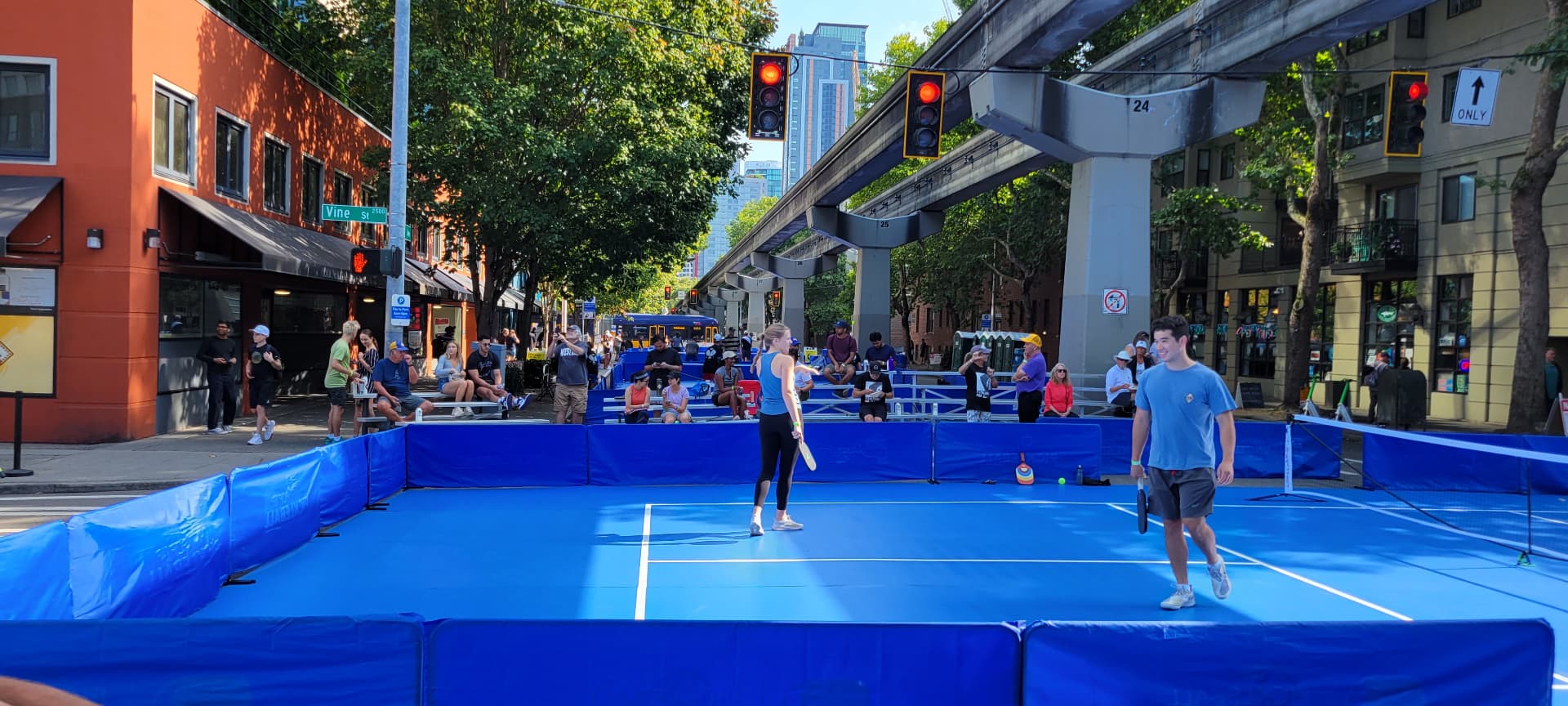
Who event and pop-up courts are for
This page is for planners, brand teams, municipalities, tournament directors, and venue managers who need regulation pickleball for a date window — not a capital project. Closed-street festivals, convention-floor championships, parking-lot activations, mall pop-ups, corporate field days, and private milestone events all share the same product problem: get real courts in, play hard, then return the venue without a poured pad or painted ghost lines. If you are outfitting a club, warehouse, gym, or school for ongoing play, start on our commercial courts page instead. Home driveways and backyard pads belong on residential courts.
Soft grass, a festival lawn, or a badly uneven lot? Read about the PickleDeck sub-surface before you assume a direct roll-out will sit true on event day.
What you get on every rented event court
Court size
20′ × 44′ regulation
Meets USA Pickleball dimensions and line specifications
Surface
Cushioned multi-layer vinyl
Tournament-legal bounce and traction
Lines
Pre-printed at manufacture
No on-site painting, ever
Install time
Under 30 minutes
Typical single court; multi-court venues in 1–2 days
These are the verified product facts we publish site-wide — court size, cushioned multi-layer vinyl, pre-printed lines, and install timing on ready surfaces. We do not invent bounce ratings, warranty year-counts, or public day-rate bands for event rentals. Partnership context: courts are fulfilled by an Official Rollout Court Partner of USA Pickleball. That marks the product path, not a blanket endorsement of every street closure or mall activation.
Why planners rent roll-out courts instead of pouring
Event pickleball fails when the court plan fights the venue calendar. A poured pad needs permits, construction windows, and a forever decision about where play lives after the festival ends. Most brand days, street festivals, and convention programs cannot absorb that timeline — and most municipalities will not let you leave a permanent hard court in the travel lane. A roll-out event court flips the constraint: regulation play for the dates you booked, then a clean teardown that returns asphalt, tile, or polished concrete to the venue’s normal use.
That is the same reason temporary courts show up in the temporary pickleball court guide and why corporate teams read the corporate event pickleball court guide before they lock a plaza diagram. The product is not a toy mat. It is a cushioned multi-layer vinyl court with pre-printed USA Pickleball-dimension lines, delivered as a rental scoped to your install and teardown windows. Compare commitment profiles in portable vs. permanent pickleball courts if stakeholders are still arguing pour-versus-rent in the planning deck.
Removability also changes risk conversations with venues and insurers. You are not asking a mall landlord to accept a permanent amenity reassignment. You are asking for a dated load-in, a play window, and a documented teardown. That packet is usually easier to approve than a capital build — especially when the court count can expand or contract if registration numbers move. We still need honest photos and surface facts; removability is not a license to ignore a hazardous lot or a soft lawn.
Surfaces that work for pop-ups and tournaments
Event courts install onto the same published surface family we use site-wide when the base is ready: concrete, asphalt, hardwood gym floors, arena decking, carpet, parking structures. On the event side, the most common ready bases are closed asphalt streets, parking lots and decks, convention and arena floors, mall concourses with protection layers, and polished concrete plazas. Hardwood gym floors appear when a school or rec center hosts a one-day tournament and needs floor protection under the court.
Compatible surfaces
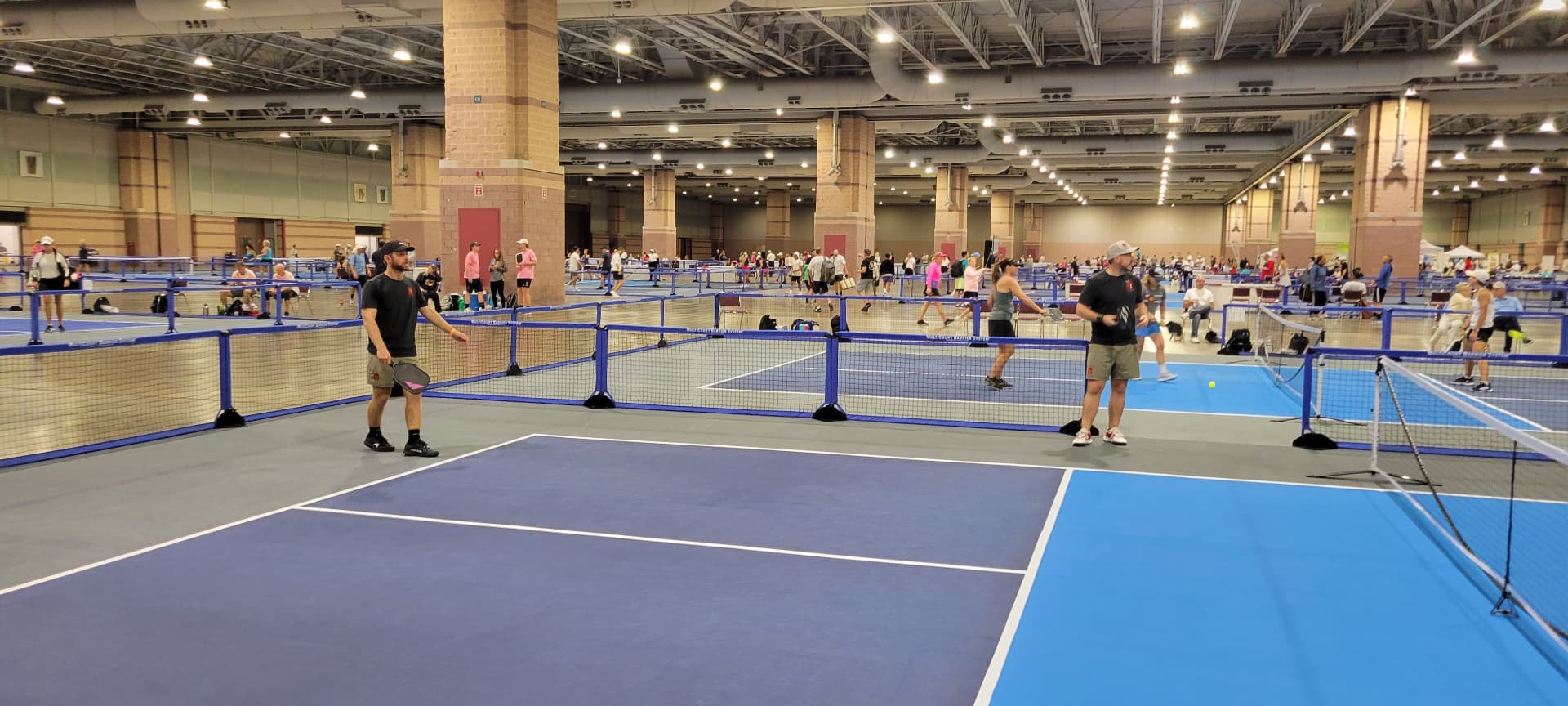
Championship venues: full convention floors, typically installed in 1–2 days
Parking-lot and street events deserve a dedicated look at drainage, crown, and vehicle residue — oil spots, loose gravel, and abrupt grade changes in the play zone show up in photos long before they show up in a bounce complaint. Start with the parking-lot pickleball court guide when the diagram lives on asphalt. Soft festival lawns and uneven park ground are a different problem: vinyl does not flatten soft earth. Those sites need PickleDeck — or another stable base — before the roll-out surface goes down. That is not upselling; it is the difference between a true bounce and a court that telegraphs every divot under live play and cameras.
Indoor convention and mall installs add floor-protection and load-in constraints more often than outdoor lots do. Freight elevators, dock schedules, overnight quiet hours, and specialty tile finishes all belong in the quote packet. We would rather plan protection and crew timing up front than discover a venue rule at 5 a.m. on install day. For surface-type tradeoffs beyond the event frame, see pickleball court surface types compared.
Court count, brackets, and the floor plan
Start with the rectangle that matters. A regulation pickleball court is 20′×44′ — that is the playing surface with pre-printed lines that meet USA Pickleball dimensions and line specifications. Event layouts almost never stop at the painted lines alone. Players need runoff behind the baselines and beside the sidelines so a wide ball does not put someone into a barrier, camera riser, sponsor wall, or spectator row. How much runoff you can spare depends on the venue: a closed two-lane street behaves differently than a convention bay with columns.
Court count is a function of format, not vibes. Round-robin social play, timed round-robin corporate mixers, and sanctioned tournament brackets burn courts at different rates. Under-building the floor creates wait lines and dead energy; over-building wastes rent and shrinks spectator space. The tournament court planning guide breaks down court-to-player ratio and how format changes the math. Pair that with pickleball court space requirements before you freeze the CAD or tape diagram.
Orientation and operations matter as much as square footage. Sun angle on an outdoor street, glare off a light-colored building, wind corridors between towers, and where queues form for check-in all change where baselines should face. Indoor arenas trade sun for HVAC noise, scoreboard sightlines, and how far players walk from warm-up to feature courts. None of those automatically disqualify a venue. They do change barrier plans, announce positions, and whether a feature court deserves extra runoff for cameras. Send a floor plan or a paced sketch with the quote — we will return an honest fit call, including a polite no when the clear span cannot support the court count you want.
Mid-read check: get an event-court quote
Already know the date, city, surface, and target court count? Send them now — with a couple of venue photos if you have them. We typically respond within one business day with a real rental quote. No public day-rate list, because a one-court plaza pop-up and a multi-court convention floor are not the same scope.
- Event date (or date range) and city
- Surface type and approximate clear length × width
- Target court count and indoor vs. outdoor
- Courts only vs. full production; load-in notes if known
Install, play window, and teardown without drama
A single court on a ready surface typically installs in under 30 minutes once the crew is on the pad — roll out, seam, perimeter adhere, nets up. Multi-court championship floors take longer because access, layout verification, barriers, and branding ride with the build. Plan crew arrival against the venue’s real load-in rules, not against the hopeful schedule in the run-of-show. Street closures need the closure active before courts go down; convention docks need freight windows that match truck timing.
During the play window, the court should feel like a real court: regulation lines, cushioned underfoot, stable at the perimeter. If something feels wrong — a lifted edge, a soft spot telegraphing through the vinyl, a barrier that migrates into runoff — stop and fix it before feature matches or live cameras make the problem worse. That is ordinary event ops, not a product mystery. Photos from walkthrough day catch most of those risks early.
Teardown is part of the promise. Courts roll onto core tubes; barriers and nets pack out; the venue returns to asphalt, tile, or polished concrete without a permanent footprint. Build teardown time into the contract the same way you build install time — overnight strikes, early-morning reopenings for malls, and municipal reopen deadlines are not optional footnotes. If your event also needs ongoing maintenance guidance for courts you own between weekends, see roll-out court maintenance; rental teardowns are a different workflow than owned-court care.
Courts only vs. full event production
Not every client wants the same scope. Some agencies already have producers, referees, and brand crews — they need regulation courts delivered and struck on time. Others want a single accountable team for brackets, on-court staffing, and the physical court build. Both are valid. What fails is a fuzzy middle where nobody owns check-in flow, nobody owns feature-court rotation, and the court vendor is blamed for production gaps they were never hired to run.
Say the lane in the quote request. Courts only means equipment, install, and teardown scoped to your dates. Full production adds planning and on-site execution for the play program — useful for corporate field days, municipal festivals, and tournaments that need more than a silent floor of courts. We will not invent headcount, spectator capacity, or “guaranteed ROI” numbers for sponsor decks. We will scope the work you actually ask for and price that work.
Brand activations sit in between. A mall or plaza pop-up often needs courts, soft barriers, and a clean visual for photography — without a full tournament desk. A sanctioned weekend may need more courts, more runoff, and tighter line discipline. Match the product package to the job so you are not renting a championship footprint for a two-hour happy hour, or under-building a finals weekend that will overflow every queue.
Pricing honesty for event court rentals
Event court pricing is quote-only. Court count, surface readiness, indoor vs. outdoor, install and teardown windows, travel, barriers or branding, and production staff (if any) all move the number. A one-court private party on a flat parking pad is not the same bill of materials as a twelve-court convention championship with overnight install. Publishing a single public day-rate would be fiction dressed as transparency.
We also will not recycle invented dollar bands from older marketing pages as if they were current rates. If you see leftover price language elsewhere on the web about event courts, treat anything not tied to a written quote as previously published context only — not a live offer. Your quote is the live number. For owned-court cost framing (buy paths, not event day-rates), the roll-out pickleball court cost guide explains what actually changes a commercial or residential package without pretending a public SKU list exists.
What helps us quote fast: date, city, venue surface, clear dimensions, court count, and courts-only vs. production. What slows everyone down: “roughly a few courts,” no photos, and a venue that has not confirmed load-in hours. Send the packet once and we typically reply within one business day.
Related guides before you lock the diagram
Deep-dive pages that pair with this rental hub: temporary pickleball courts, corporate event courts, tournament court planning, parking-lot installs, and space requirements. Product overview for buyers comparing rent vs. own lives on roll-out pickleball courts.
Event and pop-up court questions
How fast can event pickleball courts go in and out?
A single court on a ready surface typically installs in under 30 minutes. Multi-court championship layouts across a convention floor or arena usually take one to two days for the full build, depending on court count, access, and how much barrier or branding work rides with the install. Teardown rolls each court onto core tubes so the venue returns without a poured footprint or painted ghost lines.
Can roll-out courts go directly on a street or parking lot?
Yes — asphalt streets, parking lots, and parking structures are standard event surfaces when the pad is reasonably flat and free of hazards in the play zone. Uneven ground, soft grass, or a badly crowned lot may need PickleDeck or other prep before the vinyl surface sits true. Photos of the pad and a paced-off length × width let us say which path applies before install day.
Are rented event courts tournament-legal dimensions?
Yes. Rented event courts use the same regulation 20′×44′ playing rectangle, pre-printed line specs, and cushioned multi-layer vinyl class as purchased courts. That is the surface profile championship and league events use when they need regulation play without a permanent pour. Send your governing body’s line or runoff requirements with the quote if a sanctioning packet has extras beyond the published rectangle.
Do you only supply courts, or can you run the whole event?
Both paths are available. Many planners rent courts alone and keep brackets, staffing, and brand production in-house. Others want full event production — planning, brackets, on-site execution — from the same team that brings the courts. Say which lane you need in the quote request so we scope equipment versus production honestly instead of bundling work you do not want.
How much does it cost to rent pickleball courts for an event?
Pricing is quote-only. Court count, venue surface readiness, indoor vs. outdoor, install and teardown windows, barriers or branding, travel, and whether you need production staff all move the number. We do not publish flat public day-rates on this page because a one-court plaza pop-up and a twelve-court convention floor are not the same bill of materials. Send date, city, surface type, and court count — we typically respond within one business day with real figures.
What should I send with an event court quote request?
Event date (or date range), city and venue name, surface type (concrete, asphalt, convention floor, etc.), approximate clear length × width, target court count, indoor vs. outdoor, and whether you need courts only or full production. Photos of the floor or lot, load-in notes (dock, freight elevator, street closure timing), and any brand or barrier requirements prevent surprises on install day.
Will the courts damage a convention floor, mall tile, or street surface?
The court adheres at the perimeter with double-sided tape and is designed to roll up without leaving a permanent install. Indoor venues that care about finished floors get protection layers when the finish matters. We will not claim “never marks any surface under any condition” — soft asphalt in extreme heat, freshly sealed lots, and specialty mall finishes are the cases where photos and venue rules change the plan. Removability is the point of an event court: the amenity leaves with the trucks.
How is an event rental different from buying a commercial or home court?
Event rentals are scoped to a date window and a teardown — streets, festivals, brand days, tournaments, and private parties that need regulation play without a forever pour. Commercial facility buys and home installs are for courts that stay down as an amenity (even though the product remains physically removable). If you are outfitting a club, warehouse, or school for ongoing play, start on the commercial or residential pages instead of forcing a rental frame onto a permanent need.
Quote your event courts
Date, venue surface, and court count are the big three — include them and we will respond with availability and pricing, typically within one business day. Full event production is available too — just say so in your request. No public day-rate card; your quote is scoped to the real floor plan.
- Event date / city / venue
- Surface photos and clear dimensions
- Court count and courts-only vs. production
- Load-in, teardown, and barrier or brand notes