Best Pickleball Court Shade Structures & Cabana Benches for Facilities (2026)
By the PickleCourt USA team · Updated
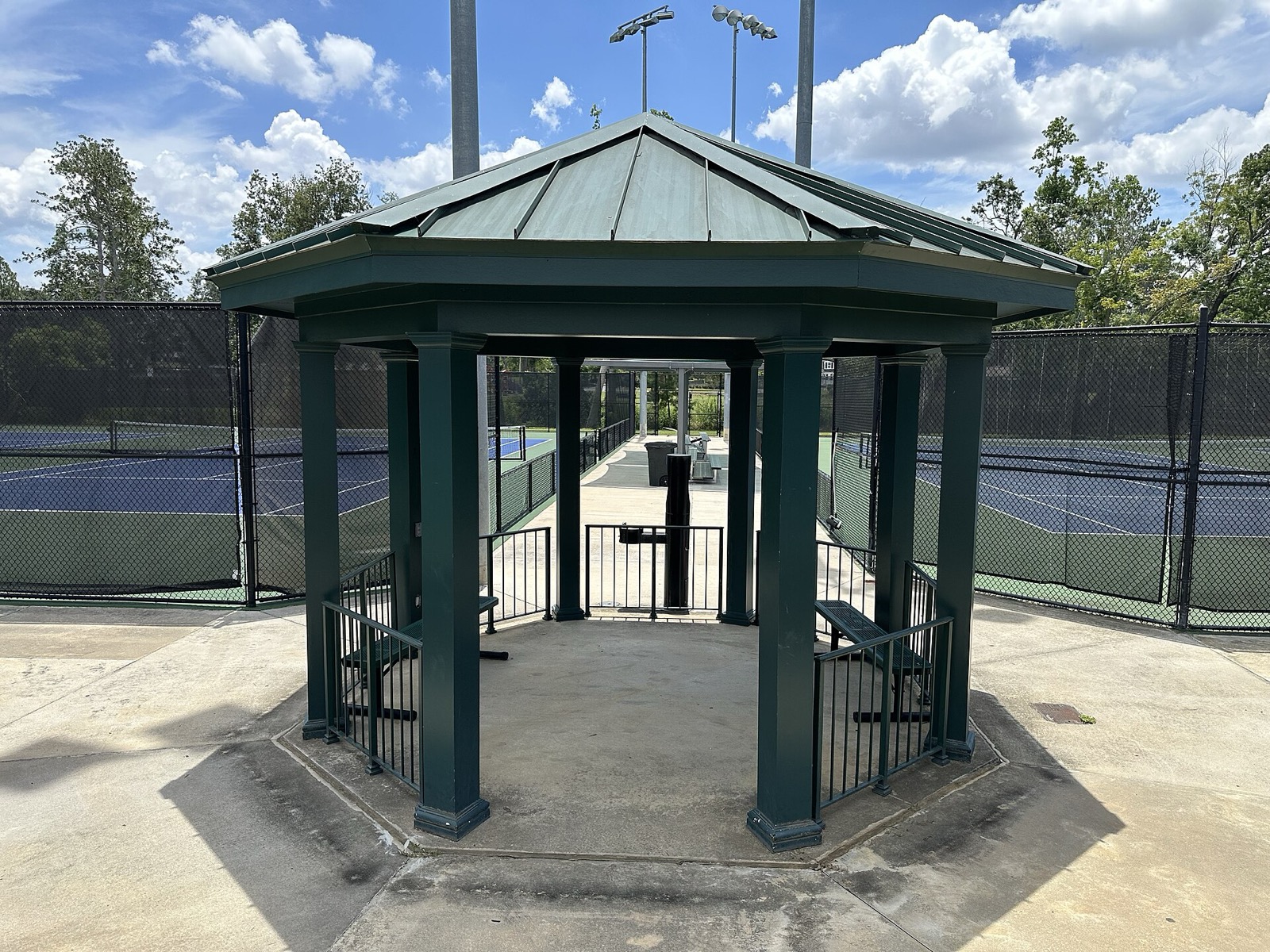
The short answer
To shade players waiting between games, start with a courtside cabana bench. Har-Tru publishes the fullest specs (sizes, post sizes and weights), Douglas offers a 4 ft-deep awning that fits against a fence, and Putterman offers printed, branded canopies and aluminum benches. To shade whole courts or spectator areas, compare engineered fabric shade from Landscape Structures SkyWays, Superior Shade and Shade Systems on their stated wind and snow limits. Superior Shade's 150 mph figure applies to the frame with the fabric removed, not with it on. For rain cover over seating, a waterproof membrane canopy such as Shade Systems Global's cantilever design is the stronger option. Everything here comes from the makers' own pages. Nobody paid to be listed, and we don't sell shade.
Who this guide is for
Parks departments, clubs, HOAs, senior-living communities, hotels and schools that run outdoor pickleball and keep hearing two complaints: there is nowhere to sit out of the sun while waiting for a court, and nobody wants to watch a midday league match from an unshaded fence line. Shade is one of the cheapest ways to make an outdoor court block usable for more hours of the day. It also carries engineering, permit and maintenance work that buyers tend to underestimate. This guide separates the two product types you will be quoted, small cabana benches and engineered shade structures, and sets out what each maker actually publishes. If you are still planning the courts, our tournament court planning guide covers layout and run-off space, and our court lighting comparison matters because shade posts and light poles compete for the same edge of the court.
Cabana benches vs. shade structures
A cabana bench is a bench with its own steel frame and canopy, roughly 6 feet wide and 6 to 10 feet long, that sits between courts or against a fence. It shades a handful of players and their bags. All three cabanas here can be surface-mounted (bolted down) or direct-buried (posts set in concrete). None of their pages publishes a wind rating, which tells you they are sold as site furniture, not engineered structures.
An engineered shade structure is a steel frame with fabric or membrane designed for site-specific loads, on footings, often with stamped drawings for a permit. It can cover a full court, a bank of bleachers or a walkway. The makers publish wind and snow limits, removal instructions for the fabric, and warranty terms. Lead times are measured in weeks of engineering plus weeks of production: Superior Shade, for example, cites roughly 2 to 3 weeks of engineering and 4 to 5 weeks of production.
How we compared them
- Size and footprint, including entry height for structures and bench depth for cabanas
- Anchoring: surface mount, direct burial or engineered footings, and who supplies the drawings
- Cover: canvas, vinyl, knitted HDPE shade fabric or waterproof PVC membrane, plus color and branding options
- Published wind and snow limits, and whether they apply with the fabric on or off
- Warranty terms as the maker states them
We left prices out. Some pages list a price or price range, but shade is quoted per site and changes with engineering, freight and footings. We did not invent ratings, and we did not repeat customer testimonials. Each table is in no particular order of quality.
Courtside cabana benches compared
| Product | Size | Anchoring | Cover | Wind / snow | Warranty | Best for | Source |
|---|---|---|---|---|---|---|---|
| Har-Tru Cabana Bench Courtside cabana bench (canopy plus bench) | 6 ft canopy with 4 ft bench, 8 ft with 6 ft, or 10 ft with 8 ft; canopy 6 ft wide and 8 ft 10 in high; bench 20 to 36 in wide | Direct burial or surface mount; steel posts 2 x 2 in (6 ft model) or 3 x 3 in (8 and 10 ft models) | All-weather canvas in five standard colors on a heavy-gauge steel frame with black powder coat | No wind rating published on the product page; weights 250, 455 and 520 lb by size | 5-year fade warranty on the canopy | Clubs that want a standard between-courts bench with published weights and post sizes | Maker page |
| Douglas Cabana Benches Courtside cabana bench (canopy plus bench) | 6, 8 or 10 ft lengths; the 8 ft unit has a 6 x 8 ft awning as standard, with 8 x 8 ft or a fence-friendly 4 x 8 ft option | Surface mount (brackets bolted to the court surface) or direct burial (poles set in a concrete foundation) | Sunbrella canvas, five standard colors, custom colors at extra charge; 3 in square steel frame with black powder coat | No wind rating published on the product page | 5-year fade warranty on the Sunbrella canvas | Tight court lines where a 4 ft-deep awning can sit against the fence | Maker page |
| Putterman Custom Court Cabana Customizable courtside cabana bench | Awning 6, 8 or 10 ft long by 6 ft wide; bench 4 ft and up | Surface mount or direct burial; heavy-gauge steel, welded and bolted with stainless fasteners | Sunbrella canvas or vinyl; large-format printing, logos, lettering and graphics available | No wind rating published on the product page | 3-year limited warranty | Facilities that want sponsor or club branding on the canopy, or an aluminum bench | Maker page |
Har-Tru Cabana Bench
Best for: Clubs that want a standard between-courts bench with published weights and post sizes
Har-Tru publishes the most complete set of physical numbers in this group, which is what a facility manager needs to plan a slab or footing. The three sizes pair a 6, 8 or 10 foot canopy with a 4, 6 or 8 foot bench, every canopy is 6 feet wide and 8 feet 10 inches high, and the bench depth runs 20 to 36 inches. Posts are 2 by 2 inch steel on the smallest model and 3 by 3 inch on the two larger ones, and the units weigh 250, 455 and 520 pounds. Each size can be direct-buried or surface-mounted. The canopy is all-weather canvas in burgundy, Pacific blue, forest green, black or a forest green and white stripe, with a five-year fade warranty. On November 9, 2026 the page listed a lead time of four to six weeks, which matters if you are opening courts in spring. The page does not publish a wind rating, so if your courts sit on an exposed site, ask Har-Tru what the canopy is designed for and whether it should come down for storms. We are not repeating the listed price. The same dimensions and weights appear on a dealer listing for a SunTrends cabana bench, so ask Har-Tru who manufactures the unit if you are comparing quotes from several dealers.
Douglas Cabana Benches
Best for: Tight court lines where a 4 ft-deep awning can sit against the fence
Douglas describes its 8 foot cabana bench in more detail than its other sizes. The standard awning is 6 feet wide by 8 feet long, an 8 by 8 foot awning is available at extra cost, and a 4 by 8 foot version is offered specifically so the unit can stand against a fence. That narrow option is the one to look at when courts are laid out with little room between the fence and the sideline. The frame is 3 inch square heavy-gauge steel with a black powder coat, and the bench is 3 by 4 inch Durawood plastic composite bolted and welded to the frame. Douglas lists three 6 foot seating layouts for the 8 foot unit: a single flat bench with a backrest, a two-sided bench with backrests, and a two-sided bench without. A two-sided bench makes sense between two courts, because players from both sides can use it. The canopy is Sunbrella with a five-year fade warranty in forest green, Pacific blue, burgundy, black or a forest green stripe, with custom colors at extra charge. Installation is surface mount, with brackets bolted to the surface, or direct burial, with poles set in concrete. No wind rating is published.
Putterman Custom Court Cabana
Best for: Facilities that want sponsor or club branding on the canopy, or an aluminum bench
Putterman's cabana uses the same basic footprint as the other two, an awning 6, 8 or 10 feet long and 6 feet wide, but gives you more choices on the parts. The canopy can be Sunbrella canvas or vinyl, the bench can be composite wood or aluminum, flat or with a backrest, and bench lengths start at 4 feet. The frame is heavy-gauge steel, welded and bolted with stainless fasteners. The feature that sets it apart is printing: Putterman offers its ENDURA large-format printing and logos, lettering and graphics, which is how a club or a sponsor gets a name on every court. The page lists a three-year limited warranty, shorter than the five-year fade coverage Har-Tru and Douglas quote for their canopies, although those are different kinds of warranty, so compare the written terms. Mounting is surface or direct burial. No wind rating is published.
Court and spectator shade structures compared
| Product | Size | Anchoring | Cover | Wind / snow | Warranty | Best for | Source |
|---|---|---|---|---|---|---|---|
| Landscape Structures SkyWays Engineered fabric shade (cantilever, hexagon, hip and custom styles) | Example: SkyWays Cantilever in 20 x 36 ft or 20 x 72 ft with 8, 10, 12 or 14 ft entry heights | Engineered footings; quotes do not specify concrete or installation labor | Knitted HDPE shade fabric; Rapid Release fabric removal standard on the cantilever | Remove fabric when wind is expected to exceed 105 mph or snow load 5 psf, per IBC 2024 (standard products); custom designs for other codes | Refers to the company's published warranty documents | Parks and schools that already buy playground equipment from the same supplier | Maker page |
| Superior Shade (SRP) Engineered fabric shade (domes, hips, cantilevers, custom) | Standard and custom sizes; example pickleball job: 97 x 65 x 14 ft eight-column Super Dome over a championship court and bleachers | Engineered spread or pier footings sized for structure, location and elevation | Traditional shade fabric (not waterproof; the maker says about 80% of water sheds); waterproof fabric on certain models | Fabric on: 75 mph sustained, 90 mph 3-second gusts; frame with fabric removed: up to 150 mph; higher loads engineered on request | 10-year limited fabric warranty (full replacement for 6 years, then pro-rated); shorter fade coverage for yellow and red | Parks departments planning a multi-court complex with spectator shade | Maker page |
| Shade Systems (CoolNet) Fabric shade over whole courts or sideline seating | Custom heights, lengths and overhangs | Engineered per project | CoolNet canopy in 22 colors; maker says it screens up to 99% of UV rays; patented Turn-N-Slide canopy fastening on many models | No wind or snow figures on the pickleball page; the canopy is designed to come off for winter or an approaching hurricane | Not stated on the pickleball page | Southern facilities that want full-court cover and plan to take the canopy down for storms | Maker page |
| Shade Systems Global Cantilever Tensara Canopy Tensile PVC membrane canopy, columns on one side | Reach, width and height custom-engineered per site | Footing details supplied; built by a local installation partner | Waterproof PVC membrane (not shade mesh); SKY W series transmits about 13 to 14% of daylight, H series about 21 to 22% | Engineered to local wind, snow and seismic codes, with load calculations and sealed engineering where required | Limited: 10-year workmanship, membrane up to 25 years (W series, pro-rata) or 20 years (H series), 10-year galvanizing, 5-year paint or powder coat | Spectator seating and sidelines that need rain cover, not only sun cover | Maker page |
Listed in no particular order of quality. Specifications are as stated on each maker's public pages on November 9, 2026 and are the makers' own figures, not our measurements. Models, options and terms change.
Landscape Structures SkyWays
Best for: Parks and schools that already buy playground equipment from the same supplier
SkyWays is the shade line from Landscape Structures, a playground maker, and its product pages are explicit about load limits. For standard products the company says to remove the fabric when wind is expected to exceed 105 mph or snow load to exceed 5 pounds per square foot, per the 2024 International Building Code, and to contact them for other codes. That snow figure is low for northern sites, so in snow country plan on taking the fabric down for winter. The cantilever model comes in 20 by 36 or 20 by 72 feet with entry heights of 8, 10, 12 or 14 feet, uses the patented Rapid Release system for removing the fabric, and covers a large area with posts on one side, which suits a sideline or a spectator row. Basic engineering drawings come with standard products, with extra charges for site-specific drawings or wet seals, and the company says its quotes do not include concrete or installation labor. The units are made in and ship from Dallas. Landscape Structures' buyer's guide says the standard fabric is a knitted mid-duty HDPE. We are not repeating the price range on the product page.
Superior Shade (SRP)
Best for: Parks departments planning a multi-court complex with spectator shade
Superior Shade's FAQ answers the questions most shade sales pages leave out. With the fabric on, its standard structures are designed for 75 mph sustained wind and 90 mph three-second gusts, and only the bare frame, with the fabric removed, is rated up to 150 mph. Read any catalog claim of 150 mph with that in mind. The company says it can engineer for higher loads, that traditional fabric is neither fireproof nor waterproof (it is fire retardant to NFPA 701 or ASTM E84, and about 80 percent of rain sheds off with the rest coming through as mist), and that waterproof fabric is available on some models. Its fabric warranty is ten years limited, with full replacement for the first six years and pro-rated after that, and it warns that yellow and red fade faster and carry shorter fade coverage. For maintenance, it says the canopy cable may need replacing about every five years, and northern and coastal customers should remove canopies in snow and hurricanes. It suggests at least 84 inches of clearance above the standing surface to discourage vandalism, galvanized frames on coastal sites, and roughly 2 to 3 weeks of engineering plus 4 to 5 weeks of production. Its Burlington, North Carolina pickleball case study describes a 97 by 65 by 14 foot eight-column Super Dome over a championship court and bleachers, built with access points for electrical wiring for lights and future speakers or monitors. We did not repeat the customer quote from that page.
Shade Systems (CoolNet)
Best for: Southern facilities that want full-court cover and plan to take the canopy down for storms
Shade Systems has a page specifically for pickleball courts. It says its structures can be designed to cover a whole court or only the sideline seating, can accommodate night lighting, and come in custom heights, lengths and overhangs. The CoolNet canopy comes in 22 colors and, according to the maker, screens up to 99 percent of UV rays. Many models use the company's patented Turn-N-Slide fastening system, which the page presents as the way to remove and reattach a canopy for winter or ahead of a hurricane. That is the practical point for most facilities: fabric shade is usually designed to come down in extreme weather, so somebody needs to own that job. The pickleball page does not publish wind or snow figures or warranty terms, so ask for the engineered design loads for your county and the written warranty before you compare it with the others.
Shade Systems Global Cantilever Tensara Canopy
Best for: Spectator seating and sidelines that need rain cover, not only sun cover
This is a different kind of product from the fabric shades above. The roof is a high-tension PVC membrane that the maker says is waterproof and blocks UV, carried on hot-dip galvanized steel columns along one side only, so the covered area and its open edge have no posts in them. That makes it a candidate for spectator seating along a sideline, where columns would block sightlines or crowd the court. The company says each canopy is engineered for local wind, snow and seismic codes, with shop drawings, footing details and load calculations, and sealed engineering where required. Its FAQ says permanent shade structures usually need a building permit. It also says that because the open side lets air through, wind-driven rain can still reach the outer edge, and it offers side screens. Warranties are limited: ten years on workmanship, up to 25 years pro-rata on the W series membrane or 20 years on the H series, ten years on galvanizing and five on paint or powder coat. Shade Systems Global and Shade Systems (CoolNet) have separate websites; we did not confirm whether the companies are related.
Also worth a call: Shade America's pickleball page describes large-span hip and sail structures arrayed across several courts, engineered to local wind and building codes, with hot-dip galvanized steel and UV-stable ShadeNet fabric. It publishes no specific load or warranty figures on that page, so we left it out of the table.
What to settle before you order
Design loads for your address
Wind and snow loads come from the building code your town enforces, not from the brochure. Ask each maker to quote against the loads your building department gives you, and to say in writing whether the published figure applies with the fabric on or off. The difference is large: Superior Shade's 75 mph sustained, 90 mph gust rating with fabric on versus 150 mph for the bare frame is the clearest example.
Who takes the fabric down, and when
Fabric shade in snow or hurricane country usually comes down seasonally or before a storm. Landscape Structures ties removal to 105 mph wind or 5 psf snow; Superior Shade tells northern and coastal customers to remove canopies in snow and hurricanes; Shade Systems builds its Turn-N-Slide fastening around removal. Put that job in your maintenance plan, with a place to store the fabric.
Posts, lights and play space
Keep columns and cabana anchors outside the playing area and the run-off space around it, and away from gates. A cantilever design, which Landscape Structures, Superior Shade and Shade Systems Global all offer, keeps posts on one side. If the courts are lit or will be, coordinate pole locations and ask for electrical access in the structure, as Superior Shade describes in its Burlington project. Our windscreen comparison is relevant too, because screens on a fence add wind load to whatever is attached to it.
Permits and approvals
Permanent shade structures usually need a building permit, and HOAs and parks boards often have their own review. Ask who produces the stamped drawings and what they cost before you sign. Our HOA court guide and parks department guide cover the approval side.
Scenarios
An HOA or senior community with two to four courts
One two-sided cabana bench between each pair of courts often solves the waiting-player problem without a permit project, depending on local rules. If residents want to watch, add a cantilever over a seating row rather than covering the courts. Our senior living court guide covers that setting.
A parks department complex that hosts tournaments
Shade the show court and the spectator areas with engineered structures, and put cabanas on the rest. Ask for electrical access in the structures for lights, speakers or displays, and get the fabric removal plan in writing.
A hot-climate club with all-day play
Full-court fabric shade is worth pricing, but check how it works with your lighting and fencing, and whether the canopy has to come down for hurricane season. Ask about galvanized frames if you are near salt water.
Planning courts with shade and seating in mind?
Tell us the site, how many courts and whether you want to buy or rent them. We'll quote a roll-out court with surface, lines and optional net packages. Quote only.
Pickleball court shade & bench FAQs
What is the best shade option for a pickleball facility?
It depends on whether you are shading people waiting to play or the court itself. For players between games, a courtside cabana bench from Har-Tru, Douglas or Putterman is the simplest choice: a 6 ft-wide canopy over a bench, surface-mounted or set in concrete. For whole courts or spectator areas, engineered fabric shade from Landscape Structures SkyWays, Superior Shade or Shade Systems covers far more area but needs footings, engineering and usually a permit. If you need rain cover as well as sun cover over seating, a waterproof membrane canopy such as Shade Systems Global's cantilever design is a different category.
How much wind can court shade structures handle?
Read the fine print. Superior Shade says its standard structures are designed for 75 mph sustained wind and 90 mph three-second gusts with the fabric on, and that only the frame, with the fabric removed, is rated up to 150 mph. Landscape Structures says to remove SkyWays fabric when wind is expected to exceed 105 mph or snow load to exceed 5 psf. The cabana bench pages we read publish no wind rating. Your local building department sets the design loads that apply at your address.
Do I need a permit for a shade structure over a pickleball court?
Usually, for a permanent engineered structure. Shade Systems Global says permanent shade structures generally need a building permit and that rules vary by city and county. Superior Shade says city projects normally need permits and that it supplies stamped drawings for the application. Ask your building department, and your HOA or landlord if there is one, before you order.
Should shade fabric come down in winter?
On most fabric shade, in snow country, yes. Landscape Structures says to remove SkyWays fabric when snow load is expected to exceed 5 psf, and Superior Shade tells northern and coastal customers to remove canopies in snow and hurricanes. Shade Systems presents its Turn-N-Slide fastening as a way to take canopies down for winter or an approaching hurricane. Budget staff time or a service contract for taking it down and putting it back up.
Is shade fabric waterproof?
Usually not. Superior Shade says its traditional fabric is not waterproof and that about 80 percent of rain sheds off, with the rest coming through as mist, though it offers waterproof fabric on some models. Shade Systems Global's PVC membrane canopy is sold as waterproof. Cabana canopies are canvas or vinyl and are described as protection from sun and passing showers.
Where should cabana benches go on a multi-court layout?
Outside the playing area and clear of gates. Douglas offers a 4 ft-deep awning so a cabana can stand against a fence, and two-sided benches let players from both neighboring courts use one unit. Check the run-off space your court plan reserves before you set posts or anchors. Our tournament court planning guide covers layout.
Does PickleCourt USA sell these shade structures or benches?
No. PickleCourt USA quotes roll-out pickleball courts (surface plus lines, with optional net packages) to buy or rent for facilities, parks, HOAs, homes and events. We are not a dealer or partner of any maker on this page, and nobody paid to be listed. If you are planning courts and want room for shade and seating, tell us about the site and we will quote the court.
Related: court lighting · best windscreens · scoreboards · tournament court planning · HOA courts
Get a roll-out court quote
Surface, lines, and optional net packages for a park, club, HOA or event. Quote-based, with no made-up price list.
Get a QuoteSources checked November 9, 2026: Har-Tru Cabana Bench; Douglas Cabana Benches; Putterman Custom Court Cabana; Landscape Structures SkyWays Cantilever and shade buyer's guide; Superior Shade FAQ and Burlington pickleball complex project; Shade Systems pickleball courts; Shade Systems Global Cantilever Tensara Canopy; Shade America pickleball courts. We are not affiliated with any maker listed, and no one paid for placement.