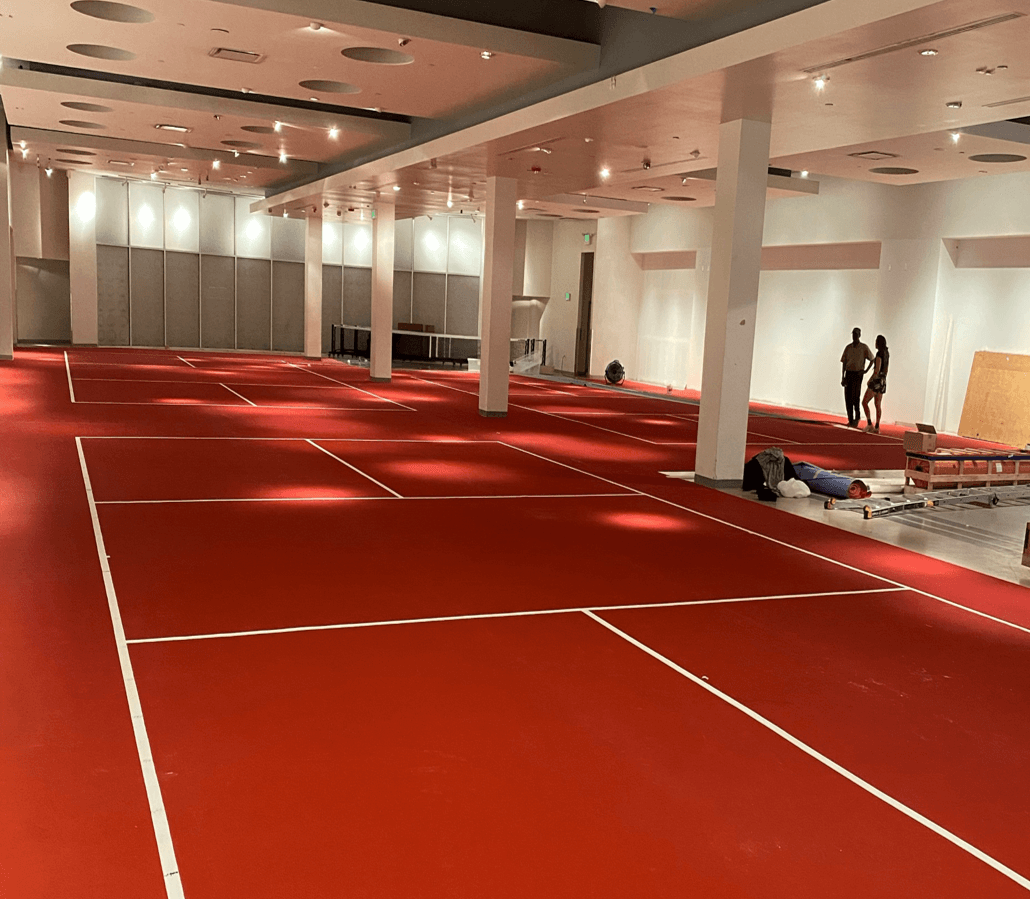
Who commercial roll-out courts are for
This page is for operators who need regulation pickleball without a permanent pour: warehouse and industrial landlords filling empty bays, gym and rec directors sharing hardwood with other sports, club builders staging multi-court venues, parking-structure owners activating dead deck space, school athletic directors adding PE courts, and multifamily managers upgrading amenity programs. If you already know you want a home driveway or backyard court, start on our residential courts page instead. For one-day activations and brand events, see event courts.
Beyond courts, our team also scopes full club build-outs — facility design, membership programs, and operations. Mention club development in your quote request and we’ll include it in the response.
What you get on every commercial court
Court size
20′ × 44′ regulation
Meets USA Pickleball dimensions and line specifications
Surface
Cushioned multi-layer vinyl
Tournament-legal bounce and traction
Lines
Pre-printed at manufacture
No on-site painting, ever
Install time
Under 30 minutes
Typical single court; multi-court venues in 1–2 days
These are the verified product facts we publish site-wide — court size, cushioned multi-layer vinyl, pre-printed lines, and install timing. We do not invent bounce ratings, warranty claims, or price bands beyond what is quoted for your site. Partnership context: courts are fulfilled by an Official Rollout Court Partner of USA Pickleball. That marks the product path, not a blanket endorsement of every facility project.
Footprint, ceiling, and layout math
The math that matters first is footprint. A regulation pickleball court is 20′×44′ — that is the playing rectangle with pre-printed lines that meet USA Pickleball dimensions. Commercial venues almost never stop at the painted lines alone. Players need run-off behind the baselines and beside the sidelines, plus room to walk between courts without stepping into a live rally. That is why operators typically plan around a 30′×60′ total playing footprint per court — about 1,800 sq ft of committed floor per court when you include safe margins. Recreational open-play can sometimes run tighter; tournament brackets and league nights want the fuller envelope. For the detailed breakdown of run-off and multi-court circulation, read pickleball court space requirements.
Translate that into bay math before you sign a lease or clear a mezzanine. A roughly 10,000 sq ft warehouse bay generally supports four to five courts if columns, dock doors, and egress paths cooperate. A big-box retail shell of 30,000+ sq ft can support a true multi-court club once you reserve space for check-in, seating, storage, and restrooms. Column grids matter as much as raw square footage: a court cannot sit with a structural column in the run-off, and shared aisles between banks of courts need to stay clear during league play. Send a floor plan or a dimensioned sketch with your quote request and we will return an honest court count — not a maximum that only works on paper.
Ceiling height is the indoor constraint people forget. About 18′–20′ clear is the practical minimum for lob-friendly play. Lower ceilings do not automatically disqualify a space, but they change the style of play and can make the room feel cramped for competitive programming. Lighting should illuminate the playing surface evenly without harsh glare in the players’ eyes; existing warehouse high-bays often work with minor aiming adjustments, while retail shells sometimes need denser fixtures over the court pads. HVAC noise and airflow matter for member comfort on long open-play blocks. None of these are secret formulas — they are the checklist we walk when we scope a commercial install.
Layout is not just tiling rectangles. Decide early whether courts share a long side (efficient, louder) or sit end-to-end with a center aisle (easier for staff circulation and spectator sightlines). Plan where nets, divider nets or barriers, ball carts, and a small staff station live when the floor is fully programmed. If the same bay must host volleyball, basketball, or events on other nights, design the roll-up path and storage footprint now — roll-out courts exist specifically so that shared-use calendar is realistic. Deep dive for industrial slabs: warehouse & industrial pickleball courts.
Surface choice and floor protection
Commercial roll-out courts install onto the surfaces we already publish site-wide: concrete, asphalt, hardwood gym floors, arena decking, carpet, parking structures. Flat, stable concrete is the most common warehouse and retail base. Hardwood gym floors are common in schools and rec centers — indoor installs include floor protection so the gym can return to basketball or assemblies without a renovation crew. Asphalt and parking structures support outdoor or deck programming when the surface is sound. Carpeted event floors and arena decking show up for temporary builds and hybrid venues. Soft grass or uneven outdoor ground is a different problem: that is when operators look at PickleDeck rather than laying vinyl on an unsuitable base.
Compatible surfaces
Protection and removal are part of the product story, not an afterthought. The court adheres only at the perimeter with double-sided tape. That perimeter bond keeps the surface stable under play, then releases so teardown does not peel finish or leave a ghost outline on a leased floor. For gym directors and landlords, that removable profile is often the decision that unlocks approval — because the capital project does not permanently reassign the asset. Compare the commitment profile against poured courts in portable vs. permanent pickleball courts.
What we will not do is invent coefficient-of-friction numbers, proprietary bounce scores, or “tournament certified in X countries” language that is not on the source product facts. The published specs are regulation size, cushioned multi-layer vinyl, pre-printed lines, and install timing. Photos of your slab, joints, and any heaving tell us more about readiness than a marketing paragraph. Deep cracks, severe slope, or active moisture issues are the exceptions that change the quote — sometimes toward prep work, sometimes toward a different product path, sometimes toward a polite no.
Buy vs. rent for operators
The second strategic question after footprint is commitment. A poured-and-painted court locks capital and floor use before the first paying player walks in. A roll-out build changes that risk profile: because the surface removes cleanly, operators can rent courts to validate demand on a short lease or pilot season, then buy once open play, memberships, or leagues prove the revenue line — or reconfigure the layout as programming evolves. Rent-to-validate-then-buy is not a slogan here; it is the operating pattern we see most often from cautious landlords and first-time club operators.
Buying makes sense when the calendar is already full, the lease term is long enough to amortize the asset, and you want the courts down as a permanent amenity (even if they remain physically removable). Renting makes sense when you are testing a new market, sharing the floor with seasonal events, staging a pop-up club inside a retail shell, or bridging until a larger build finishes. Hybrid paths exist too: rent a starter bank of courts, add purchased courts as membership grows, and keep a rental set for overflow tournament weekends. We do not publish rental day-rates or purchase SKUs on this page — every commercial package is scoped to court count, accessories, and logistics, then quoted.
If your question is really “should we pour instead?”, read the portable-vs-permanent guide linked above and be honest about permanence. Pouring wins when you own the land, want a forever outdoor hard court, and accept construction timelines measured in weeks or months. Roll-out wins when speed, removability, indoor shared use, or capital flexibility matters more than a permanent slab. Most commercial inquiries we see land in the second camp — empty square footage that needs to earn this quarter, not after a capital campaign.
Mid-project check: get a facility quote
Already know your approximate square footage and court count? Send them now — with surface type and a couple of photos if you have them. We typically respond within one business day with a real multi-court quote. No public price list, because a three-court gym share and a twelve-court warehouse club are not the same bill of materials.
- Square footage / bay dimensions
- Photos of the floor and clear height
- Target court count and buy vs. rent
- Nets, barriers, or full club scope if needed
Revenue programming (without invented dollars)
Facilities monetize commercial pickleball courts through programming, not through a magic occupancy formula we will invent for this page. The common revenue types — all real, none of them priced here — are open-play sessions, memberships or punch cards, leagues and ladders, lessons and clinics, reserved court time, and corporate or private event rentals. Which mix works depends on your trade area, hours of operation, parking, and whether you are a pure pickleball club or a multi-sport facility adding courts as one more line.
Open play fills daytime and early-evening slots when drop-in demand is strong; it needs enough courts that wait times stay reasonable. Memberships stabilize cash flow when the community is sticky enough to pay for access rather than one-off fees. Leagues and ladders create recurring midweek occupancy and give newer players a reason to come back. Lessons and clinics monetize instruction without requiring every student to join a league. Court reservations capture premium evening and weekend demand from groups that want a guaranteed pad. Event rentals — birthdays, corporate outings, brand activations — often pair with the same roll-out inventory you already use for members; see our events page when the primary job is a one-day activation rather than a standing club.
We will talk through what comparable operators run when we scope your build. What we will not do is publish fabricated “average revenue per court” charts, payback-month guarantees, or membership-ARPU claims. Those numbers depend on rent, labor, market density, and management quality — variables that do not belong in a generic web page. Your quote conversation is the right place for scenario planning; this page’s job is to get the facility fit and court package right.
Warehouse, retail, gym, club, and parking fit
Warehouses and industrial flex are the fastest-growing indoor home for commercial pickleball because the slab is already there. Clear a bay, confirm column spacing and egress, check clear height, and you can stage courts without a ground-up recreation building. Dock proximity helps load-in; active forklift lanes through the play zone are a hard conflict. Details and red flags live in the warehouse guide.
Retail shells and big-box vacancies behave like warehouses with better front-door parking and worse column surprises. The upside is visibility and existing HVAC; the watch-outs are leftover fixtures, soft flooring patches, and landlord rules about exterior signage. Many operators treat a retail pilot as a rent-first project so the lease and the pickleball demand can fail safely.
Gyms and rec centers usually care most about sharing hardwood without damage and about rolling courts up for assemblies, volleyball, or youth sports. Floor protection plus perimeter-tape removal is the reason roll-out wins over painted gym lines that fight every other sport. See gym-floor pickleball courts.
Clubs and multi-court venues are layout and operations problems as much as surface problems. Court banks, divider nets, player flow, and tournament weekends dominate the brief. Install timing for a full multi-court venue is typically one to two days once the floor is ready — not because each court is slow, but because lining up barriers, nets, and circulation takes coordination. Tournament layout notes: tournament court planning.
Parking structures and lots turn underused asphalt or deck space into playable courts, then reclaim the stalls when the event or season ends. Wind, drainage, and vehicle-control plans matter outdoors; structure decks need a surface check for coatings and slope. Start with parking-lot pickleball courts. Rooftop pads are a related but stricter case — wind, parapet setbacks, and load limits — covered in rooftop pickleball courts.
Schools and multifamily properties sit adjacent to the commercial operator brief. Campuses want PE and after-school programming without pouring a forever slab (school pickleball courts). Apartment and HOA amenity teams want a resident feature that does not trigger a special-assessment construction project (apartment-complex courts). Both still convert through the same quote path on this page when the buyer is a facility decision-maker.
When NOT to use a roll-out court
Honesty converts better than forced yeses. Do not force a roll-out commercial court onto a floor that is severely heaved, cracked through the play zone, or actively wet. Do not ignore clear-height or lighting limits that make competitive play miserable. Do not claim a court fits when run-off cannot exist because walls, columns, or dock traffic sit on the sideline. Do not treat soft lawn or broken asphalt as “close enough” — those need prep or a different product such as PickleDeck.
Shared-use conflicts are another soft no. If forklifts, loading schedules, or fire egress must cut through the proposed pads during play hours, redesign the layout or pick another bay. If the landlord forbids any adhesive — even perimeter tape — say so up front; we will tell you whether an alternate fastening approach is viable or whether the site is a poor fit. A declined quote that saves a bad install is still a good outcome for everyone.
What to send in a commercial quote
The fastest path to a useful reply is a short, complete package — not a novel. Include approximate square footage and bay dimensions (length × width), a few photos of the floor, joints, and ceiling, the surface type, your target court count, and whether you want to buy or rent (or rent first). Add notes on nets, barriers, divider curtains, storage, and whether you need help thinking through club operations. City and access constraints (freight elevator, dock-only, night install windows) prevent surprises on install day.
You do not need a CAD file to start. A phone photo of the empty bay plus paced-off dimensions is enough for a first-pass layout. If you already have a floor plan PDF, attach it. If you are comparing two candidate spaces, send both — we would rather tell you which bay earns courts than quote a weak one in isolation. Pricing stays quote-only on purpose; for how cost factors stack (without fake dollar bands), see roll-out court cost factors.
How install and teardown work
On a ready surface, a typical single court installs in under 30 minutes. The court unrolls, lines are already printed at manufacture (no on-site painting), and the perimeter is taped. Nets and any barriers follow. Multi-court commercial venues usually take one to two days end to end once the floor is clear — layout chalking, multiple rolls, divider nets, and QA across every pad add time beyond the per-court unroll. Overnight or off-hour installs are common when the facility cannot lose daytime programming.
Teardown reverses the sequence: release perimeter tape, roll the surface, protect and store or ship, return the floor to its prior use. Because adhesion is perimeter-only and indoor installs include floor protection, gym and retail operators can reclaim the space for other events without refinishing. That cycle — down for league season, up for a trade-show week, down again — is exactly why commercial buyers choose roll-out over permanent construction when the calendar is shared.
Aftercare is ordinary facility hygiene, not a specialized chemistry set. Keep the playing surface clean of grit, follow the care guidance that ships with the court, and store rolls properly if they come up for a season. For ongoing routines and storage notes, see roll-out court maintenance. We will not invent lifespan year-counts or “never wears out” claims; wear depends on traffic, UV exposure outdoors, and how the court is stored between uses.
Partnership context — without overclaiming
PickleCourt USA courts are fulfilled by an Official Rollout Court Partner of USA Pickleball. Read the public announcement for the exact partnership language. That relationship speaks to the roll-out court product path and regulation-minded specs — it is not a blanket USA Pickleball endorsement of your particular facility, membership model, or tournament calendar. When we say courts meet regulation dimensions and line specifications, we mean the published 20′×44′ playing rectangle and pre-printed lines, not a custom certification badge invented for marketing.
If you need residential courts for a homeowner driveway or backyard, use the residential path. If you need a one-off activation, use events. If soft ground is the blocker, look at PickleDeck. Everyone else with a commercial floor and a court-count goal — start the quote below.
Facility questions
How fast can a facility add commercial pickleball courts?
On ready concrete, asphalt, hardwood gym floors, arena decking, carpet, or parking structures, a single court typically installs in under 30 minutes. Full multi-court venues are usually completed in one to two days, depending on court count, barriers, and load-in access.
Do roll-out courts damage existing floors?
No. Indoor installs include floor protection. The surface adheres only at the perimeter with double-sided tape, and removal is designed to leave the venue without a trace — which is why gyms, retail shells, and clubs can share the same floor with other programming.
Can we rent courts to test demand before buying?
Yes. Renting first is a common path for operators validating pickleball programming before committing capital. The same tournament-grade surface is used either way. Many facilities rent to validate, then buy once open play, leagues, or memberships prove out.
Is the surface tournament-legal and regulation size?
Courts are regulation 20′×44′ with pre-printed lines that meet USA Pickleball dimensions and line specifications, plus cushioned multi-layer vinyl built for tournament-legal bounce and traction. Fulfillment is through an Official Rollout Court Partner of USA Pickleball.
How much space do we need per commercial court?
The playing rectangle is 20′×44′. Commercial venues typically plan around a 30′×60′ (about 1,800 sq ft) total footprint per court so players have safe run-off. Tighter spacing can work for recreational open play; tournament layouts want more. Ceiling clearance of about 18′–20′ clear is the practical indoor minimum for lob-friendly play.
What does a multi-court commercial build cost?
Pricing is quote-only. Court count, surface color package, sub-surface needs, nets and barriers, load-in access, and buy vs. rent all move the number. Send square footage, photos, surface type, and target court count — we respond with real figures, typically within one business day. We do not publish flat public prices because projects do not share one bill of materials.
When should a facility NOT use a roll-out court?
Skip roll-out (or expect prep first) when the floor is severely heaved or cracked, when clear height or lighting cannot support play, when forklift or dock traffic must cut through the play zone, or when the space cannot spare run-off beyond the 20′×44′ rectangle. Soft grass or uneven outdoor ground needs a different path — see PickleDeck for that case.
What should we send with a commercial quote request?
Square footage and approximate bay dimensions, a few photos of the floor and ceiling, surface type (concrete, hardwood, asphalt, etc.), target court count, buy vs. rent preference, and whether nets, barriers, or club-buildout help are needed. That package is enough for an honest layout and a real quote.
Price your facility build-out
Send square footage, surface type, photos, and target court count — we’ll come back with a real multi-court quote, typically within one business day. Prefer email? You can also reach us through contact.
Prefer to keep reading first? Browse buying a roll-out court, portable vs. permanent, or the full guides hub.